


A SHORT HISTORY OF KOREAN CUISINE

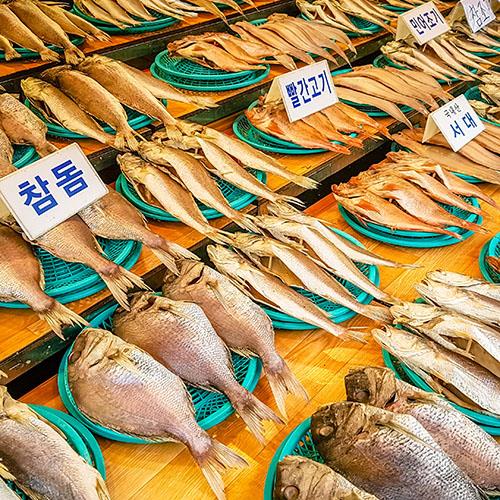
Korean cuisine dates back nearly 4,000 years. Staples like rice have always been a part of the Korean diet, with dishes such as kimchi (fermented and salted cabbage and other vegetables) becoming popular across the Korean peninsula by way of the Kingdom of Baekje (which ruled the western coast of what is now South Korea until 660 CE). The rise in ubiquity of noodles (guksu) and grilled meat (a forerunner to modern-day bulgogi) occurred during the Goryeo Dynasty (918-1392 CE). Chili peppers (gochu), sweet potatoes, and tomatoes were introduced by Korea's trading partners during the 15th and 16th centuries.
The Japanese occupation and later the Korean War were not kind to Koreans when it came to food supply, as the Japanese first took much of Korea's rice to feed Japan's people, and then during and after the war, the peninsula was left in poverty and ruin, and starvation was rampant. To survive, Koreans became very enterprising with their cooking, making do with what was available. The spicy sausage stew dish budae jjigae is a holdover from the Korean War, and is made with ingredients that were available then, ranging from ham and sausage (considered cheaper meats at the time) to baked beans and Spam (widely available due to the American forces occupying the South).
Korean cuisine came into its own beginning in the 1960s. Not only was South Korea modernizing, standards of living were rising, meaning more people were regularly eating beef and other meats. Before the 1960s eating beef was considered a status symbol as only the rich could afford it. Korea's agriculture industry blossomed and Koreans now consume more beef, dairy, bread and noodles than ever before. Also in the 1960s, Korean cuisine was introduced to the U.S. mainstream, with New York City's first Korean restaurant opening in 1960, and restaurants in San Francisco, Los Angeles, and other West Coast cities open by 1970.
Must-Savor Specialties: Kimchi, bulgogi, guksu, budae jjigae, gochu
A SAMPLING OF FOOD CITIES AND REGIONS IN SOUTH KOREA


Seoul
The largest variety of Korean cuisine can be found in the capital, Seoul. This is a city where culinary traditions, innovative fusion recipes, street food, high-end Korean gourmet cuisine, and convenient fast food all converge.
The heart of Korea can be found on its streets, and the food will capture your heart and taste buds as well. If you only have a limited time in Seoul, we recommend you visit Gwangjang Market, near Jongno 5-ga subway station. Other popular street food haunts include Myeongdong Street, nicknamed "the Food Alley"; Namdaemun Market; and the night markets at Dongdaemun and Eulji-ro in Jung-gu (Bamdokkaebi). Some street foods you should definitely try include soondae, blood sausage made with mung bean noodles and sticky rice; bindaetteok, mung bean pancakes; gimbap, similar to Japanese sushi, although Koreans insist gimbap was created independent of its better-known doppelgänger; tteokbokki, rice rolls in chili sauce; and eomukguk, fish cake soup.
Fast food is popular in Seoul, ranging from Korean fried chicken (huraideu-chikin), which can be found in abundance along Myeongdong Street, to homegrown fast food outlets such as the burger chain Lotteria, to holes-in-the-wall once frequented by taxi drivers and are now considered Korean cuisine's best-kept secrets. One of the most popular "taxi restaurants" in Seoul is Song Gane Kamjatang and Bossam Restaurant, located at 245 Donggyo-ro, Yeonnam-dong, Mapo-gu. It specializes in song ga-ne gamta-jang (potato and pork backbone stew), and has been a Seoul favorite for decades. Much like in Japan, instant noodles and other easily-prepared and/or processed foods are consumed by millions, with Nongshim and Lotte being the most popular snack brands.
High-end Korean restaurants are a new innovation, a testament to how much the Korean restaurant industry has blossomed since the first modern-day restaurant was opened in 1907. In 2009, Jungsik (11 Seolleung-ro 158-gil, Cheongdam-dong, Gangnam-gu) was opened, and since then it has earned two Michelin stars and has become the most popular Korean haute cuisine restaurant in the capital, with reservations booked out weeks in advance. An 8-course tasting menu with wine pairing costs roughly 350,000 won (about $300). (If you can't wait for a Korean vacation to try the food at Jungsik, there is also a branch located in Tribeca, Manhattan, New York City.)
Must-Savor Specialties: Soondae, bindaetteok, gimbap, tteokbokki, eomukguk, Korean fried chicken, burgers at Lotteria, Nongshim instant noodles, song ga-ne gamta-jang
Busan
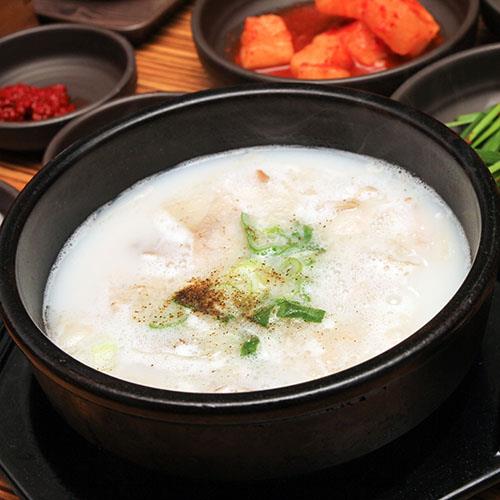
Few cities can compete with the vast selection of delicious Korean dishes that Busan offers. Busan's most popular dish is dwaeji gukbap (pictured), a milky stew which includes rice, spring onion, and lots of pork. Many people also add kimchi, gochujang (red chili pepper paste), and ssamjang (a red pepper paste with soybeans and sesame) to add to the flavor. A Busan delicacy, popular during the summertime, is milmyeon, wheat noodles that soak in a cold, beef-based broth, and is typically served with a helping of gochujang. Hoe is a white fish similar to sashimi, served with gochujang or other banchan (condiments served with the meal in tiny bowls), and wrapped in lettuce. Busan's fish markets not only sell hoe, but also every type of seafood-related snack from gaebul (a sea worm) to fish cakes (eomuk). According to many Koreans, Busan has the best-tasting eomuk in the country. For dessert, find a dessert vendor and try ssiat hotteok, a pancake made from rice flour, filled with pumpkin seeds and pine nuts cooked in a cinnamon and brown sugar glaze. During the day, visit the Jagalchi Seafood Market (52 Jagalchihaean-ro, Nampo-dong, Jung-gu), and at night, try the delicacies at Gukje Market (25 Gukjesijang 2-gil, Gwangbok-dong, Jung-gu).
Must-Savor Specialties: Dwaeji gukbap, gochujang, ssamjang, milmyeon, hoe, gaebul, eomuk, ssiat hotteok
Jeju Island
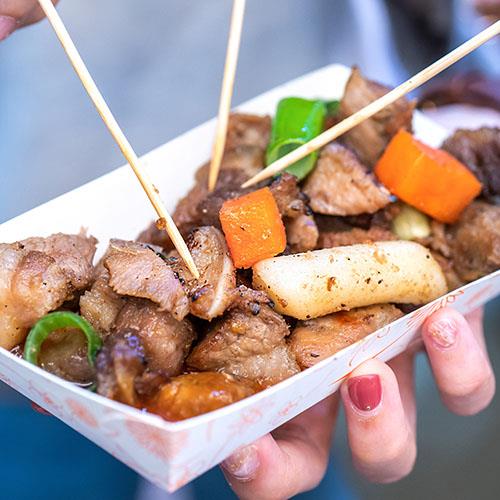
Like Busan, Jeju Island is well-known for its seafood. Popular seafood dishes that everyone must try while in Jeju include shellfish soup (haemultang), many varieties of abalone (jeonbok), and seafood hot pot (haemul ttukbaegi), the latter cooked with fermented soybean paste (doenjang). Mom guk is a Jeju delicacy, a soup made from local gulfweed, pork intestines, and pork broth. Rice is not a crop that can be easily grown on Jeju Island, so many snacks that would include rice on the peninsula, such as rice cakes, are made with millet in Jeju (and are called omegi tteok here). Buckwheat is a prized crop, and the best way to try buckwheat noodles here is to eat them in a soup with local pheasant (kkwong memil kalguksu). Finally, the most prized delicacy from Jeju is black pork, made from a special type of pig only raised on Jeju Island. Black pork barbecue (heuk dwaeji gui) is a popular dish at sit-down restaurants and can be ordered from market stalls to eat on the street (pictured).
Must-Savor Specialties: Haemultang, jeonbok, haemul ttukbaegi, doenjang, mom guk, omegi tteok, kkwong memil kalguksu, heuk dwaeji gui (black pork barbecue).
Jeonju (day trip)
Jeonju is not a city we sell at Tripmasters, but it makes an excellent day trip from Seoul (two hours by train) and Busan (three hours by train). We can't discuss Korean cuisine without mentioning its "food capital", Jeonju. It has been the epicenter of modern Korean cuisine for centuries, as it was the city that popularized "royal court cuisine", with its numerous courses and beautiful spreads, which eventually became what is known today as Korean haute cuisine. In 2012, UNESCO named Jeonju a City of Gastronomy. You can experience traditional Jeonju-style dining at Hagindang (45 Hyanggyo-gil, Pungnam-dong, Wansan-gu).
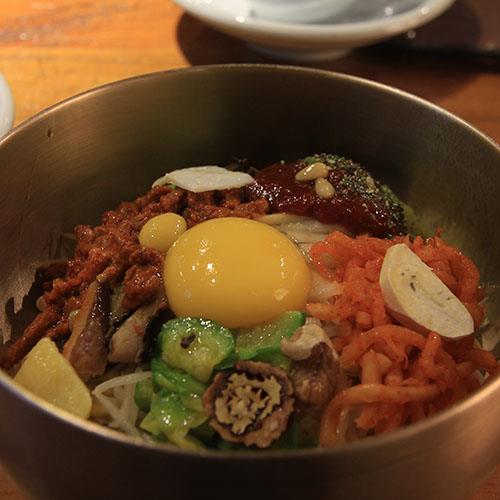
Jeonju is the birthplace of bibimbap (pictured), which are rice bowls with vegetables, sometimes egg, and gochujang. Jeonju is so renowned for its bibimbap that there is a yearly festival dedicated to just that one dish, typically held in the month of October. Makgeolli, made from fermented rice, is the most popular alcoholic drink in Jeonju as it also has roots in the city. You can order many small plates of Korean delicacies at the numerous makgeolli bars throughout town. For street food treats such as patbingsu (shaved ice with sweet red beans), head to Hanok Village. Speaking of sweet treats, Jeonju is also home of the Choco pie, which was first baked here in 1951 and has since spread nationwide and worldwide.
Must-Savor Specialties: Bibimbap, makgeolli, patbingsu, Choco pie