


Destinations
❮Main Menu
Top Italian UNESCO World Heritage Sites

Archaeological areas of Pompeii, Herculaneum and Torre Annunziata
The ruins of Pompeii and Herculaneum were a great tragedy saved in time. It was 79 AD when Mount Vesuvius, a volcano near the Bay of Naples, erupted, burying the ancient city of Pompeii and more than 2,000 of its inhabitants under a thick carpet of volcanic ash. The vast expanse of the commercial town of Pompei contrasts with the smaller but better-preserved remains of the holiday resort of Herculaneum, while the superb wall paintings of the Villa Oplontis at Torre Annunziata give a vivid impression of the opulent lifestyle enjoyed by the wealthier citizens of the Early Roman Empire.
The cities were abandoned, only to be rediscovered in 1748 by a group of explorers looking for artifacts. In the last 27 years, many archeologists have studied the site to discover buildings, frozen skeletons, and everyday objects from the Roman times. They even found jars full of fruit and a loaf of bread.

Botanical Garden (Orto Botanico), Padua
Located in northeast Italy, this botanical garden was created in Padua in 1545 by the Venetian Republic, making it the oldest botanical garden that is in its original location. The layout is still original - a circular central plot, symbolizing the world, surrounded by a ring of water. The garden measures over 5.4 acres and is noted for its historical design and large collection. Other elements that were added later include some architectural (entrances and balustrades) and some practical (pumping installations and greenhouses). It continues to serve its original purpose as a center for scientific research.

The Last Supper - Church and Dominican Convent of Santa Maria delle Grazie, Milan
The site includes an entire complex with the refectory of the Convent of Santa Maria Delle Grazie as the main architectural feature. The construction began in Milan in 1463 and was reworked at the end of the 15th century by Bramante. On the north wall is The Last Supper, the work of Leonardo da Vinci painted between 1495 and 1497, whose work was to herald a new era in the history of art. The site was included in the UNESCO World Heritage Sites in Italy in 1980.

City of Verona
The city of Verona, located in northern Italy, was founded in the first century BCE. The city flourished under the rule of the Scaliger family in the 13th and 14th centuries, and as part of the Republic of Venice from the 15th to the 18th centuries. Verona’s artistic heritage is what has earned its inscription into UNESCO - there are several operas, shows, and annual fairs held in the city of Verona. In addition, this is also the home to an ancient Roman amphitheater which was also used for theatrical performances during ancient times. The city has preserved a remarkable number of monuments from antiquity, the Medieval and Renaissance periods, and represents an excellent example of military stronghold.

Amalfi Coast
The Amalfi Coast is an area recognized for its exceptional beauty and natural diversity. It has been settled by human communities since the early middle ages with a number of established towns such as Amalfi and Ravello with architecture and artistic works of great significance. The rural areas show the versatility of the inhabitants in adapting their use of the land to the diverse mountainous landscape, which ranges from terraced vineyards and orchards on the lower slopes to wide upland pastures.
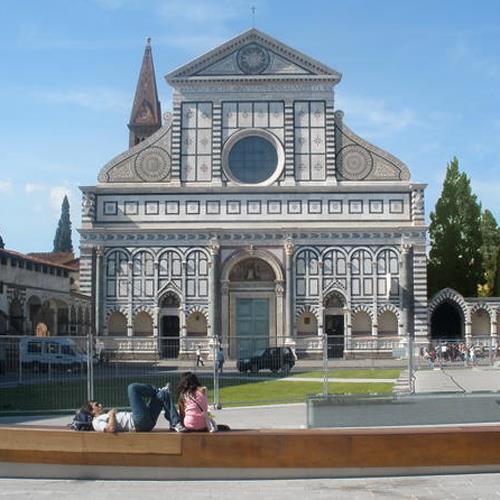
Historic Center of Florence
The historic center of Florence, built on the site of an Etruscan settlement, is an architectural and artistic attraction. The city has become a symbol of the Renaissance in Italy, rising to economic and cultural pre-eminence under the Medici in the 15th and 16th centuries. The historic center features extraordinary artistic activity that can be seen above all in the 13th-century cathedral, Santa Maria del Fiore, the Church of Santa Croce, the Uffizi and the Pitti Palace, the work of great masters such as Giotto, Brunelleschi, Botticelli and Michelangelo.
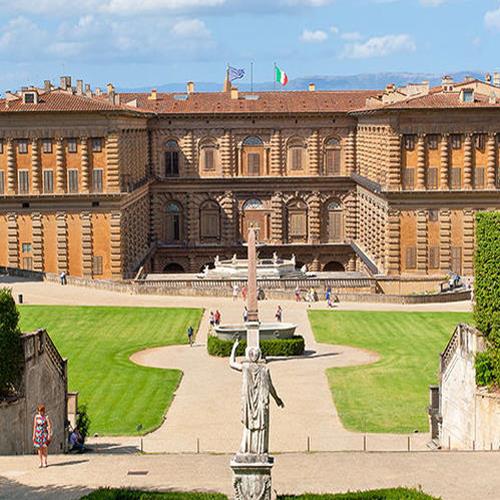
Medici Villas and Gardens in Tuscany
The twelve gorgeous Medici Villas and two gardens spread across the Tuscan landscape make up this UNESCO World Heritage site that was added to the list in June of 2013. Built between the 15th and 17th centuries, they exemplify modern European culture and rural construction that was in harmony with nature. The villas embody an innovative form and function, a new type of princely residence that unlike the farms owned by rich Florentines of the period, they exemplified the first of the connection between architecture, gardens and the environment.
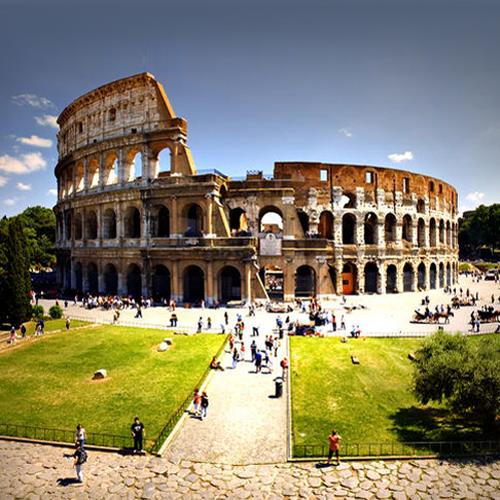
Historic Center of Rome
Rome was the first center of the Roman Republic and the Roman Empire, and it was established as the capital of the Christian world during the 4th century. In 1990, the UNESCO World Heritage Site listing was expanded to include the walls of Urban VIII to include several monuments of antiquity such as the Forums, the Mausoleum of Augustus, the Mausoleum of Hadrian, the Pantheon, Trajan’s Column of Marcus Aurelius, as well as the religious and public buildings of papal Rome.

Venice and its Lagoon
Spreading over 118 small islands, Venice became a maritime power during the 10th century. The entire city is an astounding architectural masterpiece in which even the smallest building contains works by some of the world’s greatest artists such as Giorgione, Veronese, Titian, and Tintoretto.
Venice is an open-air museum that seems to float on its lagoon. Visitors can walk its entirety if they want to, crossing its characteristic calle or vias, its campi and campitelli (piazzas and little piazzas, to be exact) and its magnificent bridges. Or they can watch the city go by from the comfort of a boat, an ideal vantage point to observe all the beautiful scenery this unique place has to offer.

Cinque Terre (Meaning Five Lands)
Stretching 9.3 miles along the eastern Ligurian coast between Cinque Terre and Portovenere, the jagged, steep coastal landscape has over centuries been developed with stone walled terraces for the growing of vines and olive trees. The layout of the small towns within the area and how they blend seamlessly with the landscape has earned them the designation from UNESCO.
The Cinque Terre area was almost inaccessible, except by sea, until the Genoa-La Spezia railway was built in the 1870s. The land, extending from the Punta Mesco in the west and to the Punta Persico in the east, encompasses the territory of Porto Venere, the three islands of its archipelago (Palmaria, Tino and Tinetto), and the Cinque Terre, the collective name of the five villages of Monterosso, Vernazza, Corniglia, Manarola and Riomaggiore. The settlements that were established here is proof of the humans’ ability to adapt to the surroundings, overcoming the disadvantages of the steep, uneven terrain, and thrive over the past millennium.
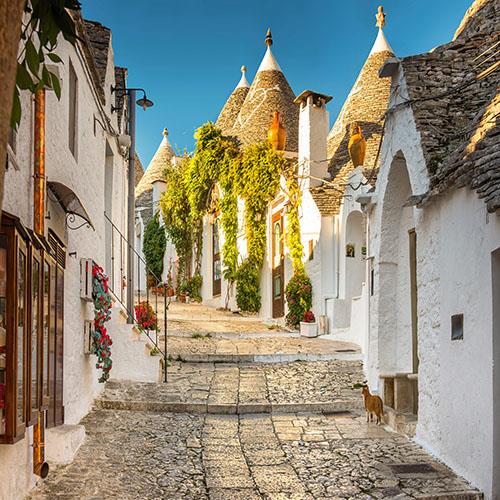
Alberobello
Located in Puglia, Trulli is a collection of limestone dwellings that showcase the use of dry stone construction with a pyramid-shaped roof, a well-known building technique used during prehistoric times. The trulli is the term used to refer to the roughly worked limestone boulders that were obtained from fields near the region. They are common in the entire Itria Valley as rural shelters for livestock or agricultural equipment, but in Alberobello it is possible to see entire concentrations: in the historical center alone there are more than 1,500 almost all in perfect condition. These were listed as UNESCO World Heritage in 1996 as significant examples of spontaneous architecture inserted in an urban and landscape context of great historical value.

Matera - Sassi di Matera
Situated in Southern Italy in Basilicata, Matera is an ancient habitation known for its sassi (stone) districts containing houses carved out of stone. A dense myriad of narrow streets and alleyways fill up with the lights in the evening, giving off the impression that one is strolling through a Nativity scene of paper-mache. Due to its resemblance to ancient Middle Eastern cities, Matera has been used as a backdrop for Biblical and other types of movies, such as Mel Gibson’s The Passion of the Christ. This was designated a UNESCO World Heritage Site in 1993.

Pisa - Piazza del Duomo, Pisa
The Piazza dei Miracoli or Piazza of Miracles (Square of Miracles), as it was nicknamed, is one of the wonders of the world and an iconic symbol of Italy. Set over an ample green field, you’ll find the gravity defying Leaning Tower (also the Bell Tower), the Camposanto (the graveyard), the Cathedral, and the huge Baptistery which is the largest in the world. Each of these buildings is considered a masterpiece of majestic Medieval art. The beauty of the complex goes as far as to be called Pisa’s architectural gems ‘miracles’ by the famous Italian poet Gabriele D’Annunzio.

Puglia
Puglia is situated in the southernmost region of Italy boasting stunning coastline, quaint little towns, beautiful countryside, and oh so very Italian way-of-life. Not only does Puglia offer an array of enchanting cities, but you will also find remarkable monuments and fascinating UNESCO World Heritage Sites. These sites include Trulli or Alberobello (see above), near Bari; Castel Del Monte, near Andria; Sanctuary of San Michele Arcangelo, near Foggia; and just an easy reach from Puglia, Matera and its Sassi (stones).
A trullo (plural, trulli) is a traditional dry stone hut building with a conical roof. This quirky type of construction is unique to the Itria Valley in the center of Puglia, Italy. Near Andria, visit the Castel Del Monte, a towering 13th century castle that has been perfectly preserved. It was commissioned by Emperor Frederick II and considered an enduring symbol of Italy’s medieval military architecture. Listed in 2011, the Sanctuary of Sa Michele Arcangelo, located in the Northern park of Puglia, is a fascinating complex of holy buildings dating back to different historical ages. Lastly, the old city center of Matera, appointed European Cultural Capital fri 2019, is a UNESCO World HEritage Site. Matera isn’t technically located in Puglia, but it’s just a stone's throw away from Bari, the region’s picturesque capital. The rock-cut ‘troglodyte settlement’ is renowned as the finest in the Mediterranean. It offers visitors a glimpse into the hidden lives of the ancient pastoral communities that lived here over two millennia ago.

Sicily
One of the pearls of Southern Italy, Sicily is the largest of the Italian islands, just off the "toe" of Italy's "boot." Sicily is rich in UNESCO World Heritage Sites, which include 6 sites listed of historical, cultural, and natural importance. The sites include the archeological area of Agrigento, the famous Valley of the Temples, and Syracuse with the Necropolis of Pantalica.
The Valley of the Temples, located outside the town of Agrigento in Sicily, is one of the most impressive complexes of ancient Greek buildings outside of Greece. These Doric temples date back to the 5th century BC, when Agrigento was one of the greatest cities in the Mediterranean region. The 12th-century Cathedrals of Monreale and Cefalù are famous for their mosaics and architectural style which combines elements derived from the architectural and artistic techniques of Byzantine, Islamic, and Western traditions.

Su Nuraxi di Barumini, Sardinia
Enchanting Sardinia, situated in the middle of the Mediterranean Sea, offers a blend of old-world traditions and a wild and pure nature. This is also where the archaeological site of Su Nuraxi di Barumini is located, which is the best-known example of the unique form of Bronze Age defensive complexes known as nuraghi. The complex consists of circular defensive towers in the form of truncated cones built of dressed stone, with corbel-vaulted internal chambers. The complex at Barumini, which was extended and reinforced in the first half of the 1st millennium under Carthaginian pressure, is the finest and most complete example of this fascinating form of prehistoric architecture. The elevated position of Su Nuraxi dominates a vast and fertile plain to the west of the municipal district of Barumini. The site was occupied from the time of construction of nuraghe in the 2nd millennium BCE until 3rd century CE.
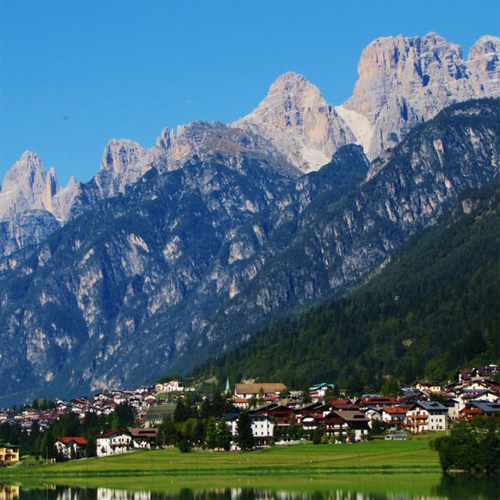
Bolzano - The Dolomite Holiday Regions
Once belonging to Austria, Bolzano has only been part of Italy since the end of World War I. It is a fascinating city at a crossroads between Italian and Austrian cultures. This is also one of the towns surrounded by the beauty of the Dolomites - a true paradise. The site of the Dolomites comprises a mountain range in the northern Italian Alps, numbering 18 peaks, which rise above 9,843-ft. It features some of the boat stunning mountains landscapes, with vertical walls, sheer cliffs and a high density of narrow, deep and long valleys. There are nine areas that present a diversity of the most beautiful landscapes of international significance for geomorphology marked by steeples, pinnacles and rock walls, the site also contains glacial landforms and karst systems. It is characterized by dynamic processes with frequent landslides, floods and avalanches.
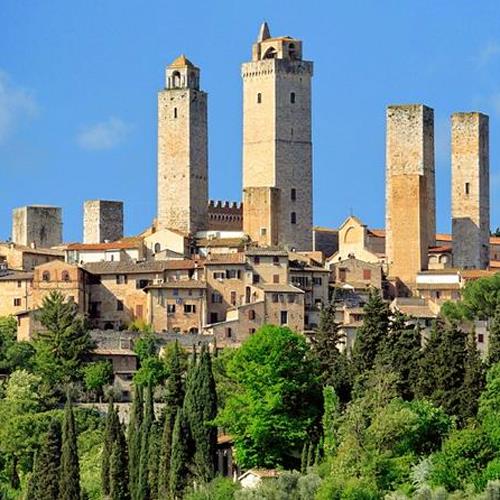
Historic Center of San Gimignano
The Historic Center of San Gimignano is situated on the peak of the land, dominating the surrounding landscape. It is located 35 miles south of Florence and served as an important relay point for pilgrims traveling to and from Rome on the Via Francigena. The town became independent in 1199 and between the 11th and 13th century the noble families and upper middle-class merchants who controlled the free town built many fortified tower-houses (about 72) as symbols of their wealth and power. The town grew around the two principal squares - the triangular Piazza della Cistema and the PIazza Duomo. After 1353, the town went into a period of decline due to waves of famine and plague that caused a drastic decrease in population that also prevented the town from the urban renewal that transformed many Italian historical towns after the Middle Ages. Because of this, San Gimignano has preserved its authenticity, as well as the strict enforcement of the restoration principles.

Historic Center of Siena
Siena is a city belonging to the Tuscany province of Italy. It is also the capital of the Siena province. The historic center of Siena is recognized by UNESCO as an important cultural heritage property. Hence, it was added to the list of UNESCO World Heritage Sites in Italy in 1995. The historic center is not only recognized for its cultural value but also a notable tourist attraction. It is a city famous for its medieval cityscape, cuisine, museum, and arts. As you explore, you will notice the city's Gothic appearance that was acquired between the 12th and 15th centuries. During this period the work of Duccio, the Lorenzetti brothers, and Simone Martini were to influence the course of Italian and, more broadly, European art. The whole city of Siena, built around the Piazza del Campo, was devised as a work of art that blends into the surrounding landscape.