


UNESCO WORLD HERITAGE SITES IN CHINA

The Great Wall - Beijing
The Great Wall of China is a fascinating feat of engineering stretching from East to West from Shanhaiguan on the Yellow Sea to the Gobi Desert’s Jiayuguan. Work on the wall began around 220 BCE by the great Emperor Qin Shi Huang and continued on the huge fortifications until the 17th century. The Great Wall is considered one of the greatest construction projects in the history of human civilization. It stretches through 15 provinces and can be called a miracle on account of its vast engineering and majestic momentum. The Great wall features some impressive watchtowers, gatehouses, and passes along with spectacular natural scenery. It extends for 13,048 miles across China and was built to protect the country against enemies like the Huns. The Great Wall was declared a UNESCO World Heritage Site in 1987.
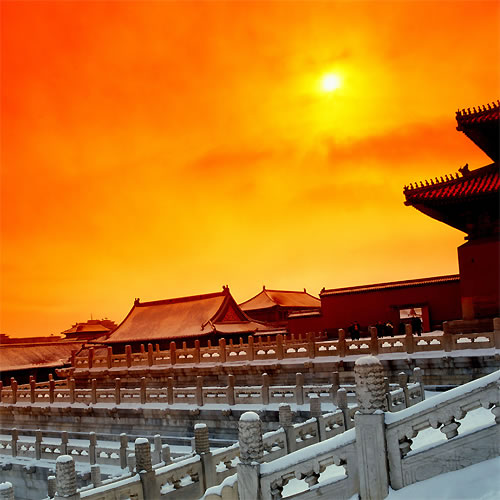
The Forbidden City - Beijing
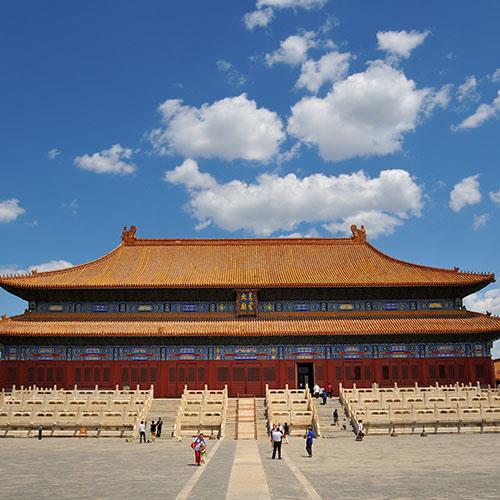
The Forbidden City in Beijing is also called the Imperial Palace Museum located in the heart of the city. The massive complex features 10,000 buildings and gardens that were constructed in the 15th century when the country’s capital moved from Nanjing to Beijing. It was the residence of the emperors for almost 500 years and was the actual and symbolic seat of imperial power. Built during the Ming Dynasty between the 4th and 18th years of teh Yongle period (1406 - 1420 AD), it was the center of Imperial power from 1416-1911. It was listed as a UNESCO World Heritage Site in 1987 and is also listed by UNESCO as the largest collection of preserved ancient wooden structures in the world.
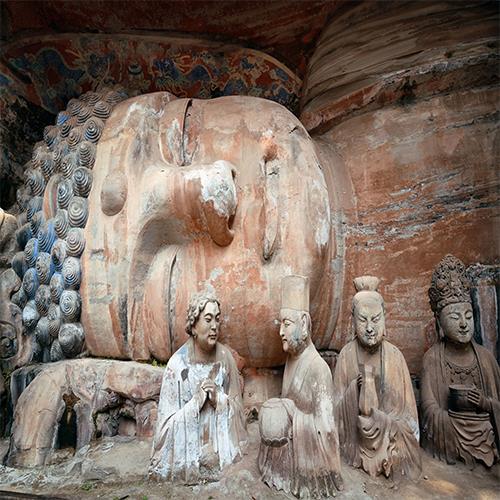
The Dazu Rock Carvings - Chongqing
The Dazu Rock Carvings area is a series of Chinese religious sculptures and carvings listed as a UNESCO World Heritage Site in 1999. Located on a steep hillside in the Dazu District in Chongqing, the area covers 41,267 acres containing an exceptional series of rock carvings dating from 650 AD during the Tang Dynasty. These remarkable carvings are known for their aesthetic quality, the rich diversity of subject matter, and both secular and religious providing outstanding evidence of the harmonious synthesis of Buddhism, Taoism, and Confucianism. The area is made up of 75 protected sites that contain some 50,000 statues featuring over 100,000 Chinese characters forming inscriptions and epigraphs. Dazu County is reputed as ‘the county of rock carving’ and the largest cluster of rocks can be found at Beishan containing two groups that sit along a cliff face that rise up to 32 feet and stretch for around 984 feet.
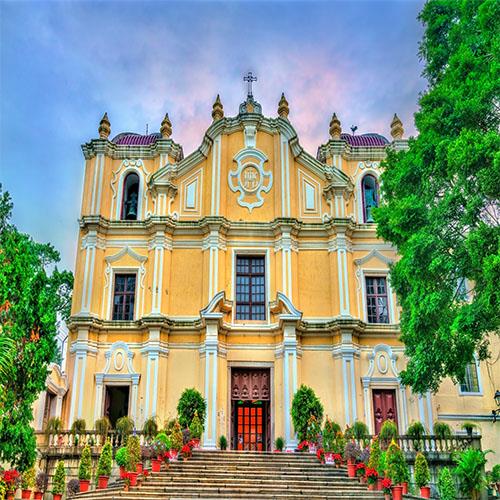
The historic center of Macau - Macau
The historic center of Macau (Macao) is a collection of over 20 locations that witness the unique assimilation and coexistence of Chinese and Portuguese cultures in the city, which is a former Portuguese colony. The lucrative port city was an international trading center from the mid 16th century until 1999, it was listed as a UNESCO World Heritage Site in 2005, making it the 31st designated site in the country. The historic center features a unique blend of western and traditional Chinese buildings that include a fortress, and the oldest lighthouse in China along with churches, temples, public buildings, and urban squares. It bears witness to one of the earliest and longest-lasting encounters between China and the West, based on the vibrancy of international trade. The city has a modern and lavish lifestyle with casinos and a bustling tourist industry, it is known as the gaming capital of Asia. Notable attractions include St. Paul’s Church, and Largo do Senado (Senate Square) both are known as the heart of old Macau.
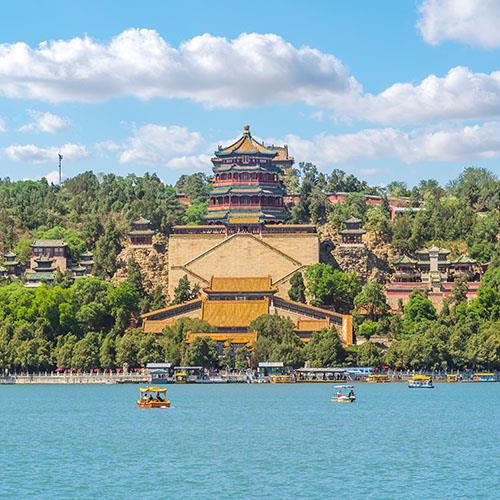
The Summer Palace of the Qing Dynasty - Beijing
The Summer Palace of the Qing Dynasty is a vast ensemble of lakes, gardens, and palaces located in Beijing. The palace was built between 1703 and 1792 in Chengde and was listed as UNESCO World Heritage Site in 1998, and was reported as “a masterpiece of Chinese landscape garden design”. Inside the palace grounds is Longevity Hill which reaches 200 feet high and features many buildings positioned in sequence, the central Kunming Lake covers 540 acres entirely man-made, and the Seventeen Hole Bridge covers 1.1 square miles with ¾ of it being water. There are over 3,000 various Chinese ancient buildings housing a collection of over 40,000 kinds of valuable historical relics from each dynasty. The stunning palace gardens are said to be the best-preserved imperial gardens in the entire world, and the largest of their kind in China, just 10 miles from the heart of Beijing. The natural landscapes of the vibrant gardens are filled with hills and open water combined with artificial features like pavilions, halls, palaces, temples, and bridges that form a harmonious ensemble of outstanding aesthetic value.
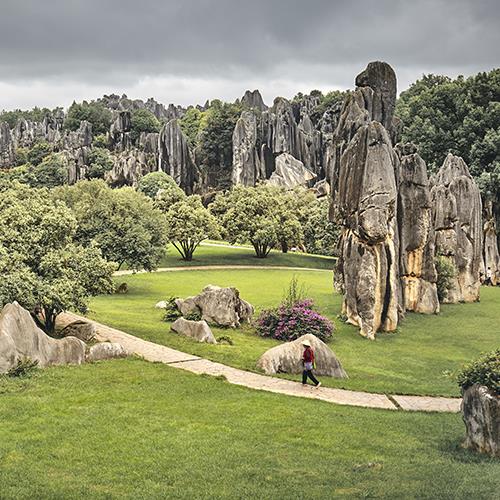
South China Karst - Chongqing
South China Karst is one of the world’s most spectacular examples of humid tropical to subtropical karst landscapes including spires and cones and other magnificent and peculiar landscapes like natural bridges, and giant sinkholes. There are a series of sites spread over the provinces of Guizhou, Guangxi, Yunnan, and Chongqing which cover over 97,000 hectares and include the Guilin Area, Stone-Forest Scenic Spot, Maolan National Karst Forest Nature Reserve, and the Wulong Area. These areas contain the most significant types of karst landforms, including tower karst, pinnacle karst, and cone karst formations, along with other spectacular characteristics such as natural bridges, gorges, and large cave systems. The sites were included on the UNESCO World Heritage Site in 2007, it was inscribed in two phases, the second phase was added in 2014. The Guilin Karst component in Guangxi province is located within the Lijang National Park containing the fenglin (tower), and fengcong (cone) karst formations. Guilin Karst is divided into two sections; the Putao Section and the Lijiang Section. The Shibing Karst in Guizhou includes dolomitic karst formations located within Wuyanghe National Park. The Jinfoshan Karst component is a unique karst table mountain surrounded by towering cliffs. Jinfoshan Karst is located in Chongqing province within the boundaries of the Jinfoshan National Nature Reserve and Jinfoshan National Park. The Huanjiang Karst component is a cone karst area located in Guangxi Province within the boundaries of the Mulun National Nature Reserve.
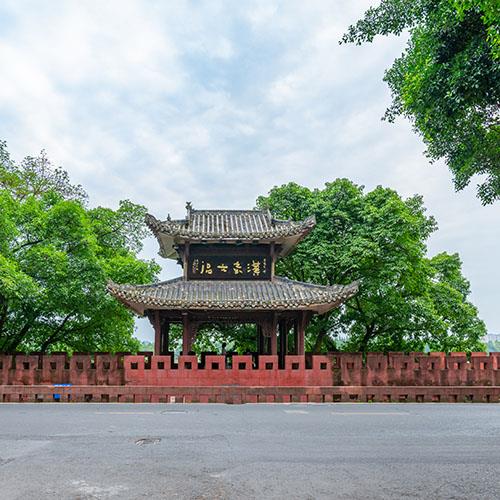
Xanadu - North of Beijing
The site of Xanadu is located north of the Great Wall of China between the former Mongolian capital the Karakorum and the Han center Dadu (Beijing) where the remains of Kublai Khan’s legendary summer capital of the Yuan Dynasty. The site shows a unique mixture of Mongolian and Han Chinese traditions, the city was built in 1256 and became the summer capital in 1274, it became an important stopping place along the silk route, in 1368 it was conquered by the Ming and destroyed. In 2012, Shangdu was made a UNESCO World Heritage Site for its historical importance and the unique blending of Mongolian and Chinese cultures. The site sits on the edge of the Mongolian plateau and features the former city with temples and places, water control works, tombs, natural features like grassland and wetland, and a traditional oboe (stone cairn) shrines of the Mongolian nomads. The city is roughly square-shaped and covers an area of 1195 acres that consisted of the Outer City, the Imperial City, and the Palace city. The site was planned according to traditional Chinese Feng shui, in relation to the nearby mountains and river.
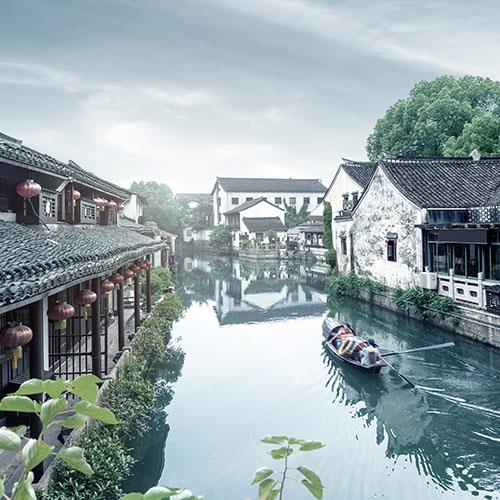
The Grand Canal - Beijing - Hangzhou
The Grand Canal is known to the Chinese as the Jing-Hang Grand Canal is a UNESCO World Heritage Site and a vast waterway system starting in Beijing, and passing through Tianjin, and the provinces of Hebei, Shandong, Jiangsu, and Zhejiang to the city of Hangzhou. It is the longest canal or artificial river in the world and links the Yellow River and the Yangtze River. The Grand Canal was constructed in sections from the 5th century BC onwards and was conceived as a unified means of communication for the Empire for the first time in the 7th century AD. The Canal played an important role in reunifying north and south China and formed the backbone of the Empire’s inland communication system, transporting grain and strategic raw materials. The total length of the Grand Canal is 1,104 miles it reaches a great height of 138 feet at the summit of the Shangdong mountains.
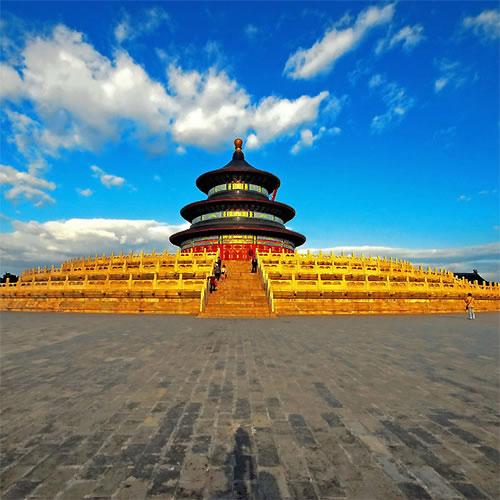
The Temple of Heaven - Beijing
The Temple of Heaven is an imperial complex of religious buildings that are situated in the southeastern part of central Beijing. Founded during the first half of the 15th century and was visited by the Emperors of the Ming and Qing dynasties for annual ceremonies of prayer to Heaven for a good harvest. The temple is surrounded by beautiful gardens and historic pine woods and the buildings symbolize the relationship between earth and heaven, the human world, and God’s world. It was inscribed on the UNESCO World Heritage Site in 1998 and declared as ‘a masterpiece of architecture and landscape design that simply and graphically illustrates a cosmogony of great importance for the evolution of one of the world’s greatest civilizations’.
The Zhoukoudian Peking Man Site - Beijing
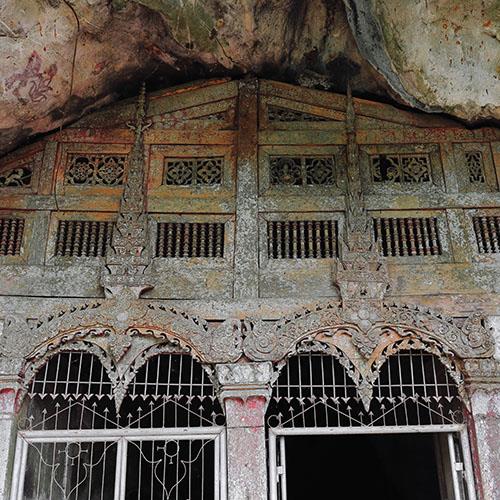
The Zhoukoudian Peking Man Site also romanized as Choukoutien, is a cave system in suburban Fangshan District, situated 26 miles southwest of Beijing, a Pleistocene hominid site on the North China Plain and the Yanshan Mountains. The remains of Sinanthropus pekinensis were discovered at the site, and remains of homo sapiens dating as far back as 18,000-11,000 BC. The area is filled with natural limestone caves and adequate water supplies that provided an optimal survival environment for early human settlement. Ancient human fossils, cultural remains, stone tools, and animal fossils have been discovered at the site and scientific work is still underway. The Peking Man Site was first discovered in1921 by Johan Gunna Andersson and first evacuated by Otto Zdansky in 1921 and 1923 that unearthed two human teeth.

The Mausoleum of the First Qin Emperor - 22 miles from Xi’an
The Mausoleum of the First Qin Emperor is the oldest and largest imperial tomb in Chinese history. Qin Shi Huangdi (259 BC - 210 BC) was the first emperor of China, who ascended to the throne at the age of 13, at this time the construction of his tomb began and was completed in 210 BC. There have been three pits found since 1974 that lie 1 mile east of the cemetery where 8,000 terracotta warriors and horses, 100 chariots, and tens of thousands of weapons were unearthed. The Qin Terracotta Warriors and Horses are world-famous, they are located 22 miles away from Xi’an on the Lishan Mountain overlooking the Wei River. The lay of the land from Lishan to Mount Hua is shaped like a dragon according to Chinese geomancy, the Imperial tomb is set at the eye of the dragon, chosen well by the emperor. The costumes, expressions, hairstyles, and gestures of each terracotta warrior are different, each revealing their personality and strong characteristics of the Qin people. They were made over 2,000 years ago and the faces still almost seem alive.
ADDITIONAL UNESCO WORLD HERITAGE SITES IN CHINA
The Ancient City of Pingyao - Shanxi Province
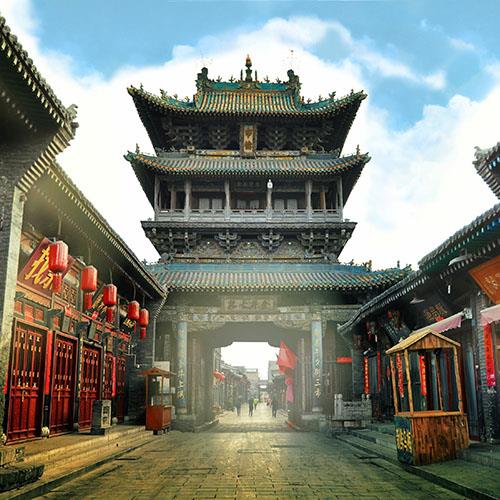
The ancient city of Pingyao is a tiny city about 1 ½ mile across located in central Shanxi Province about 60 miles south of Taiyuan. The ancient city is famous for its importance in Chinese economic history and for the well preserved Ming and Qing urban planning and architecture, the city’s impressive walls and historic architecture are remarkably still intact and is listed as a UNESCO World Heritage Site. Legend has it that the original city of Pingyao was founded in the 9th century BCE and was once the banking capital of China. The town is an outstanding example of a Han Chinese city of the Ming and Qing Dynasties known as one of the “Four Best Preserved Ancient Cities” in China along with the ancient city of Lijian, Langzhong, and Shexian. The area covers 225 hectares and includes three parts; the entire area within the city walls of Ping Yao, Shuanglin Temple, and the Zhenguo Temple. The ancient city features charming streets and lanes lined with some 4,000 shops, grand dwellings, and temples.
The Ming and Qing Tombs - Liaoning Province
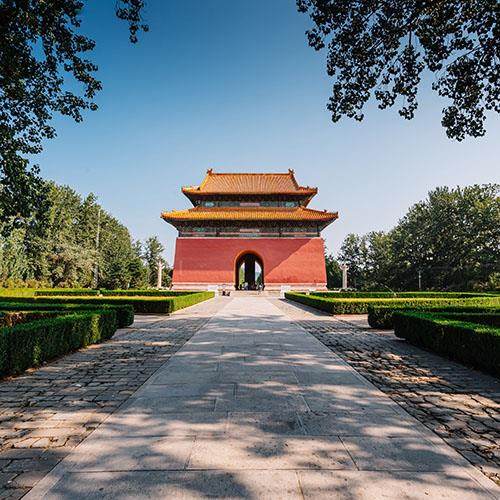
The Imperial Tombs of the Ming and Qing Dynasties are a UNESCO World Heritage Site and include several tombs and burial complexes listed in 2000 and 2003. Located in the Liaoning Province the three imperial tombs; the Yongling Tomb, the Fuling Tomb, and the Zhaoling Tomb were all constructed between 1368 and 1915 AD for the founding emperors of the Qing Dynasty and their ancestors. The tombs feature rich decor of stone statues and carvings with tiles with dragon motifs, illustrating the development of the funerary architecture of the Qing Dynasty. The three tomb complexes and their numerous edifices combine traditions inherited from previous dynasties and new features of Manchu culture. The tombs and buildings are laid out according to Chinese hierarchical rules and incorporate sacred ways lined with stone monuments and sculptures designed to accommodate ongoing royal ceremonies as well as the passage of teh spirits of the dead.
The Capital Cities and Tombs of the Ancient Koguryo Kingdom - Ji’an
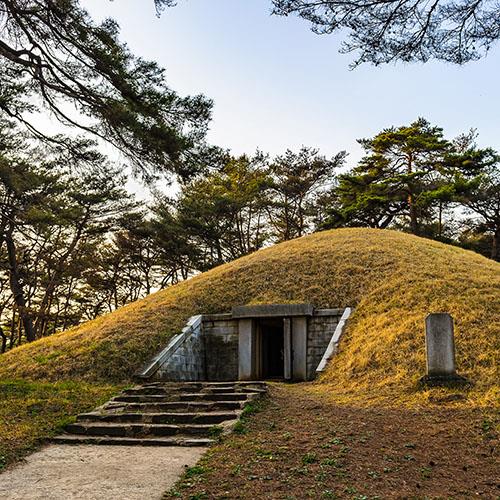
The Capital Cities and Tombs of the Ancient Koguryo Kingdom is a collection of archeological sites located in Ji’an, Jilin Province, and Huanren, Liaoning Province in Northeast China. The sites were listed as a UNESCO World Heritage Site in 2004, the designation includes archaeological remains of three fortress cities; Wunu Mountain City, Gungnae, and Hwando, and forty identified tombs of Goguryeo imperial and noble families. All the sites belong to the Koguryo culture which was named after the dynasty which ruled over parts of northern China and the northern half of the Korean Peninsula from 277 BC to AD 668. Wunu Mountain City was built in 37 BCE as the first capital of the Koguryo regime, it was surrounded by a defense wall with three gates, the city included a palace, military camp, watch-tower, houses, and warehouses. Guonei City is now surrounded by the city of Ji’an, it was built on the plain with a stone-built defensive wall with a separate palace and residential zones. Wandu Mountain City was the only Koguryo mountain city capital with a general layout planned with a large palace at its core. Wandu Mountain City and Guonei City were the economic, political, and cultural centers of the Koguryo for hundreds of years, Guonei was destroyed in 197 CE, Wandu Mountain was built in 209 CE, both were damaged in wars and rebuilt several times, and served as alternating capitals.
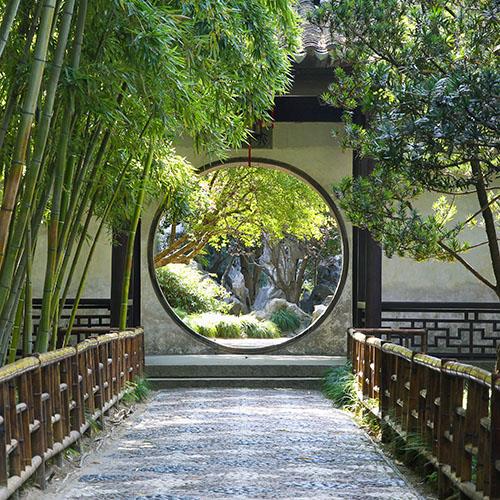
The classical Chinese gardens of Suzhou - Jiangsu Province
The classical Chinese gardens of Suzhou were built between the 11-19th centuries, these gardens are beautiful examples of classical Chinese garden architecture. Historically, Suzhou was synonymous with high culture and elegance, it's a major city located along the southeastern edge of Jiangsu Province in eastern China. Suzhou is famous for its charming canals, romantic water towns, thousand-year-old temples, and world-class museums. The historic streets are filled with ancient architecture and fantastic cuisine options along the riverside. The gardens of Suzhou, date back to the 6th century BCE when the city was founded as the capital of the Wu Kingdom, private gardens emerged around the 4th century and reached a climax in the 18th century. There are over 50 gardens still in existence today including the Humble Administrator’s Garden, the Lingering Garden, the Net Master’s Garden, the Mountain Villa, the Lion Grove Garden, the Garden of Cultivation, the Couple’s Garden Retreat, and the Retreat and Reflection Garden all are regarded as the finest embodiments of Chinese “Mountain and Water” gardens. Suzhou gardens are intended to be a microcosm of the natural world, incorporation basic elements such as water, stones, plants, and various types of buildings of literacy and poetic significance.
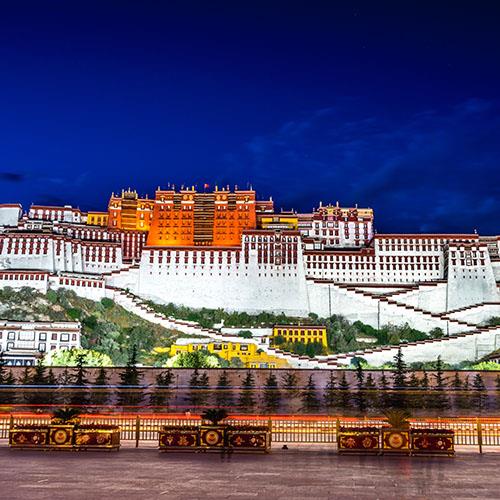
The Potala Palace - Lhasa Valley
The Potala Palace symbolizes Tibetan Buddhism and its central role in the traditional administration of Tibet. The palace complex is located on Red Mountain in the heart of the Lhasa Valley and comprises the Red and White Palaces with their ancillary buildings. The complex is known for its fascinating integration of the physical structure into the landscape of Tibet and the intricacy and beauty of its traditional Tibetan Buddhist ornamentation. The Jokhang Temple Monastery is an exceptional Buddhist religious complex founded in the 7th century, and Norbulingka was the former summer palace of the Dalai Lama constructed during the 18th century, a masterpiece of Tibetan architecture. The White Palace contains the main ceremonial hall where the throne of the Dalai Lama is located along with his private rooms and audience hall. There are 698 murals, almost 10,000 painted scrolls, numerous sculptures, carpets, canopies, curtains, porcelain, jade, and fine gold and silver objects, as well as a massive collection of sutras and important historical documents. Further up the mountain is the Red Palace which contains the gilded burial stupas of past Dalai Lamas, and further west is the Namgyel Drtshang, the private monastery of the Dalai Lama. The Jokhang Temple Monastery was founded in the 7th century to prompt Buddhism, it is located on 2.5 hectares in the heart of the old town of Lhasa and features an entrance porch, courtyard, and Buddhist hall surrounded by accommodation for the monks and storehouses. The buildings house over 3,000 images of Buddha and other deities and historical figures along with treasures and manuscripts.
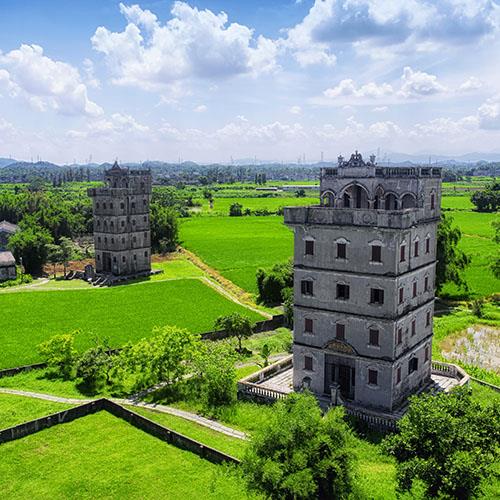
The Kaiping Diaolou - Kaiping
The Kaiping Diaolou and their surrounding villages are fortified multi-storied defensive village houses and watchtowers located in Kaiping, displaying a complex of flamboyant fusion of Chinese and Western structural and decorative forms. The villages demonstrate Outstanding Universal Value for their complex and confident fusion and reflect the significant role of emigre Kaiping people in the development of several countries in South Asia, Australasia, and North America, during the late 19th and early 20th centuries. There are four groups of Diaolou and twenty of the most symbolic ones are inscribed on the UNESCO World Heritage Site list in 2007. The buildings take three forms; communal towers that were built for several families, and used as temporary refuge, residential towers built by individual rich families, and used as fortified residences. The four separate Kaiping villages areas are Sanmenli, Zilicun, Jinjiangli, and Majianglong village clusters. The villages became the first world heritage site for overseas Chinese in the whole of China, and in 2006 it has won the golden prize of the “Top 50 places worth vising in China for foreigners”.
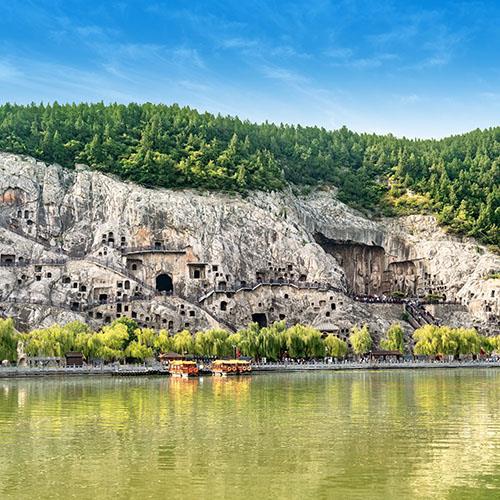
The Longmen Grottoes - Luoyang
The Longmen Grottoes, ‘Dragon’s Gate Grottoes’, or Longmen Caves are some of the finest examples of Chinese Buddhist art. There are 100,000 statues of Shakyamuni Buddha and his disciples housed here, located 7.5 miles from present-day Luoyang in Henan province. The site was added to the UNESCO World Heritage Site in 2000 as “an outstanding manifestation of human artistic creativity” for its perfection of an art form, and its encapsulation of the cultural sophistication of Tang China. The Buddhist stone carvings in the grottoes, caves, and niches of Yaoyang City date from the period between 316-907 CE during the Northern Wei and Tang dynasties. These images were mainly painted and carved as outside rock reliefs and inside artificial caves excavated from the limestone cliffs of the Xiangshan, and Longmenshan that run east and west. The Yi River flows northward between them, the alternative name of the “Dragon’s Gate Grottoes” derives from the resemblance of the two hills that check the flow of the Yi River to the typical “Chinese gate towers”, it once marked the entrance to Luoyang from the south. The 100,000 statues are found within 2,345 caves that range from 1 inch to 57 feet in height, there are almost 2,500 stelae, and inscriptions, hence the name “Forest of Ancient Stelae”.
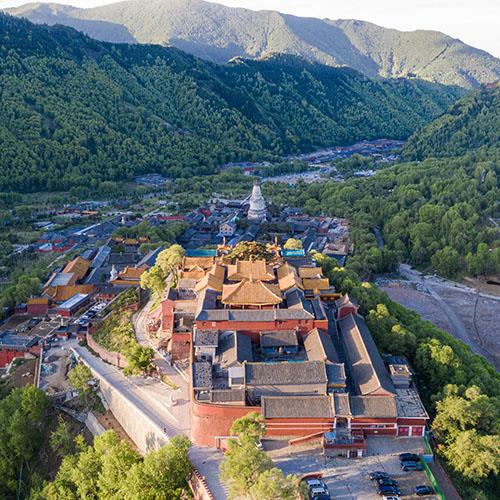
Mount Wutai - Shanxi Province
Mount Wutai also known as Wutaishan and Mount Qingliang is a sacred Buddhist site in Shanxi Province, home to 41 monasteries that include the Foguang Temple from the Tang dynasty, and the Ming dynasty Shuxiang Temple. The monasteries and temples were inscribed as a UNESCO World Heritage Site in 2009 and named an AAAAA tourist attraction by China’s National Tourism Administration in 2007. The centralized area is surrounded by a cluster of flat-topped peaks roughly corresponding to the cardinal directions, the north peak (Beitai Ding or Yedou Feng) which is the highest peak soaring to 10,043 feet, making it the highest peak in China. Mount Wutai, literally “the five terrace mountains” is one of the Four Sacred Mountains in Chinese Buddhism, each of the mountains is viewed as the bodhimanda of one of the four great bodhisattvas. Wutai is the home of the Bodhisattva of wisdom. The East Main Hall of the Fo Guang Temple is the highest surviving timber building of the Tang dynasty, the Shuxiang Temple is a massive complex featuring over 500 statues that represent Buddhist stories. With its high peaks, snow-covered most of the year, and thick verdant forests filled with vertical pines, firs, poplar, and willow trees with lush grassland. These beautiful landscapes have been celebrated by artists since at least the Tang Dynasty.
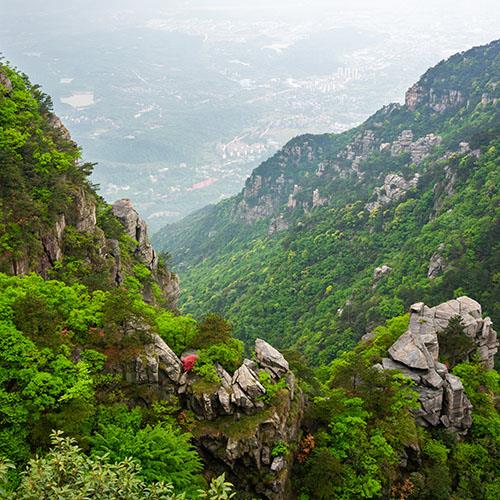
Lushan National Park - Jiangxi Province
Lushan National Park officially named Mountain Lu National Park is a mountain and park area in the Jiangxi Province in central China and contains Buddhist, Taoist, and Confucianist sites of interest. Mount Lu is one of the most renowned mountains in the country and the slopes inspired several poets, priests, and scholars through the ages. The mountain is oval-shaped and is 16 miles long and 6.2 miles wide, it neighbors Jiujiang city and the Yangtze River. The highest point is the Dahanyang Peak which reaches 4,836 feet above sea level and is one of the hundreds of steep peaks that towers above a sea of clouds that encompass the mountains for almost 200 days out of the year. The mountain and surrounding region are one of the “spiritual centers” of China that contains Buddhist and Taoist temples in addition to landmarks of Confucianism. Lushan National Park was listed as a UNESCO World Heritage Site in 1996 due to its striking beauty, and sacred importance. The park area features over 200 historic buildings, complexes of prayer halls that have been rebuilt and extended many times that create an ongoing center for study and religion.
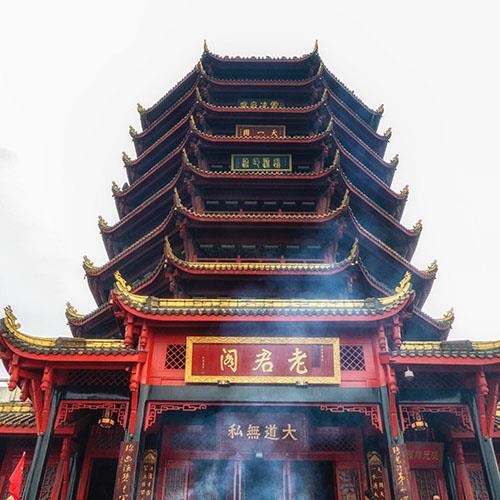
Mount Qingcheng - Sichuan Province
Mount Qingcheng is located in the Sichuan Province and is known as the birthplace of Taoism, and features ancient Taoist temples that are scattered throughout the landscapes. The Dujiangyan Irrigation system was established in the 2nd Century BCE and still controls the waters of the Minjian River today and distributes it to the fertile farmland of the Chengdu plains. Mount Qingcheng is known as the fifth most famous Taoist mountain of China, it covers an area of over 75 miles and boasts 36 peaks that are covered in thick verdant forests of trees and bamboos. There are 108 scenic spots in the area and 72 caves as well as stunning scenic scenery. The Dujiangyan is an ancient irrigation system in Dujiangyan City, Sichuan, China originally constructed around 256 BC. The system was designed by King Zhao of Qin as an irrigation and flood control project and is still in use today to irrigate over 2,000 square miles of land in the region.
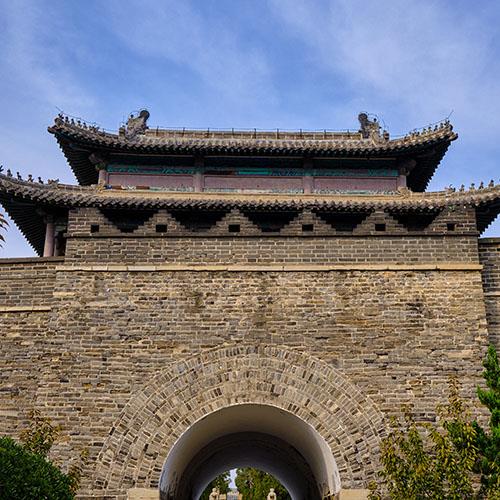
The Temple and Cemetery of Confucius and the Kong Family Mansion - Qufu
The Temple and Cemetery of Confucius and the Kong Family Mansion in Qufu is the birthplace of Confucius, which is arguably the most influential philosopher, politician, and educator in China. The temple was first built in honor of Confucius in 478 BCE and has been rebuilt over the centuries, Confucius’ tomb and an estimated 100,000 of his descendants, and the great man’s family mansion featuring 152 buildings still remain today. The temple and cemetery were listed on the UNESCO World Heritage Site list in 1994. The site covers a massive area and boasts over 100 halls, pavilions, and other buildings that are clustered around nine courtyards, there are over 10,000 trees planted here by Confucius’ leading disciples, as well as the Apricot Altar where his school was located and the famous cypress tree he planted and over 1,000 stone tablets. Kong Shangren an author of the drama, The Peach Blossom Fan is also buried here. This temple is the first, largest, and oldest temple to venerate Confucius, an ancient architectural complex in the country, and second only to the Forbidden City visited by a total of 12 different emperors.
Yin Xu - Henan Province
Yin Xu (Yinxu) is located in the Henan Province, an archaeological site of the Shang Dynasty featuring palaces and tombs that yield the rich history and culture of the Chinese Bronze Age. The site is one of the ancient and major historical capitals of China, the source of the archeological discovery of oracle bones and oracle bone script, that resulted in the identification of the earliest known Chinese writing. The archaeological ruins of the ancient city of Yin, the last capital of China’s Shang Dynasty that existed for eight generations for 255 years through the reign of 12 kings. It was rediscovered in 1899 and sits on both banks of the Huanhe River, and is comprised of two sites; the Palace and Royal Ancestral Shrines Area and the Royal Tombs Area. This was the earliest site to possess the elements of civilization, which includes over 80 house foundations of rammed earth with the remains of timber structures, ancestral shrines, and altars enclosed within a defensive ditch that also functioned as a flood-control system. The Royal Tombs are situated on a higher ground that includes sacrificial pits that contain chariots and human remains considered to have been sacrificial victims. Burial goods included decorated bronze ritual vessels, jade, and bone carvings, and ceramics.
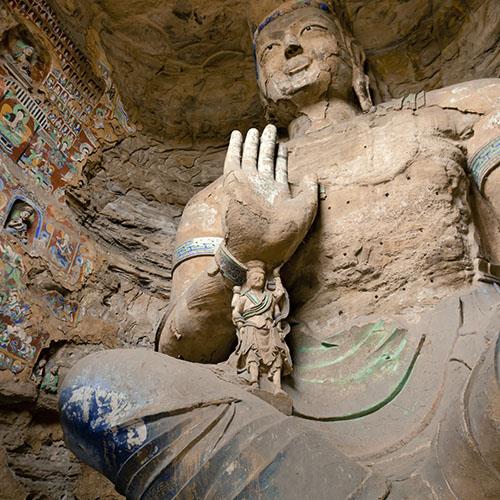
The Yungang Grottoes - Datong
The Yungang Grottoes formerly the Wuzhoushan Grottoes are ancient Chinese Buddhist temple grottoes near the city of Datong, located in the province of Shanxi. The grottoes were originally built in Northern Wei Dynasty (368-534) and the excavation of the Yungagn Grottoes lasted for over 60 years from the beginning of Emperor Wencheng (460) to the fifth year of Emperor Xiaoming (524). During ancient times it was traditional for Buddhists to excavate caves on mountains into shrines where they would practice their religion. The major caves and Buddha scriptures of Yungang Grottoes were built over the 60 years, and it became the first royal style Buddhist art treasure carved by a nation, taking an entire dynasty to build. The Buddhist culture and art displayed in teh grottoes involve many aspects such as architecture, history, and music, and was listed as a UNESCO World Cultural Site in 2001 and praised as ‘the masterpiece of early Chinese Buddhist cave art’.
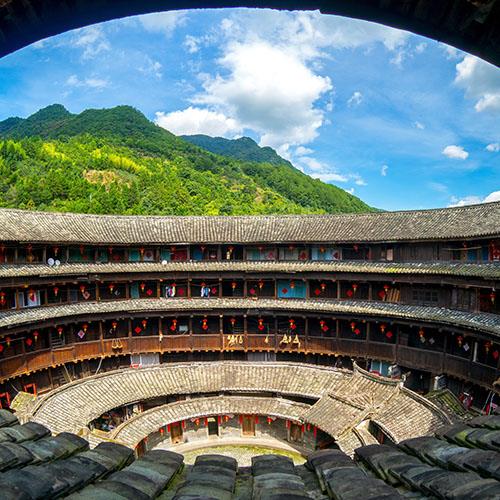
The Fujian Tulou - Fujian province
The Fujian Tulou is a property consisting of 46 circular clan houses built between the 12th - 20th centuries in the Fujian province, located inland from the Taiwan Strait. A tulou is usually a large, enclosed, and fortified earth building, most commonly rectangular or circular in configuration with very thick load-bearing rammed earth walls between three and five stories high that can house up to 800 people. The eastern structures were constructed to house a large number of people and designed to primarily supply a defensive habitation for communal living. The interiors of these multi-story buildings are highly decorated with tall mud walls and have interior gardens. The living quarters are all in the circle with a village ‘square’ set in the middle and have a look of an amphitheater or bullfighting ring, they are set amongst rice, tea, and tobacco fields. The Fujian tulou, and their extensive associated documentary archives, reflect the emergence, innovation, and development of outstanding art of earthen building over seven centuries.
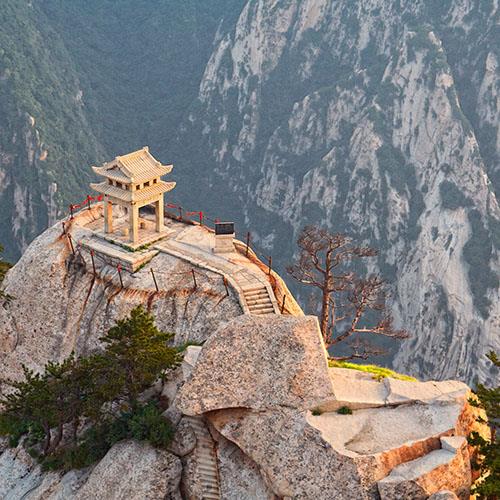
The Zuojiang Huashan Rock Art Cultural Landscape - Guangxi Province
The Zuojiang Huashan Rock Art Cultural Landscape is located in Guangxi Province in southwest China. These 38 sites depict ancient rock art from the 5th century BC to the 2nd century AD illustrating the life and rituals of the Luoyue people. The magnificent rock art is set on the steep cliffs in the border regions of southwest China with tableland landscapes filled with karst, rivers, and plateaux depicting ceremonies that have been interpreted as portraying the bronze drum culture that was once prevalent across southern China. The Zuojiang Huashan Rock Art Cultural Landscapes boasts an extensive assembly of historical rock painted on the limestone cliffs that face Guangxi, on the west bank of the Ming River, a tributary of the Zuo River. The site was listed on UNESCO’S World Heritage Site in 2016, with paintings on cliffs that reach up to 130 feet in height and 560 feet wide, making them one of the largest rock paintings in the country. The paintings have a red color and were made using a mixture of red ochre, animal glue, and blood, they depict human figures as well as animals and bronze drums, knives, swords, bells, and ships.
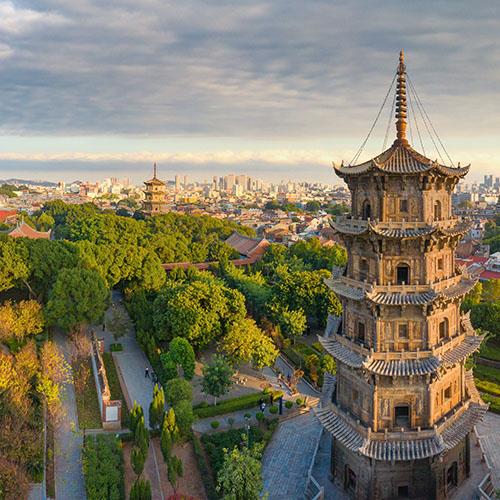
“Quanzhou” the Emporium of the World - Fujian Province
“Quanzhou” the Emporium of the World in Song-Yuan China was once known as Zayton in Arabic, it was an important trading center during the 10th - 14th centuries. The site includes Qingjing Mosque, Islamic tombs, and several archeological remains. Listed as a UNESCO World Heritage Site in 2021. Quanzhou is a coastal city situated in the Fujian Province of China and bears impressive maritime memories with a history dating back over 1,300 years. The city rose up as the largest port in the East, with a prosperous maritime trade along with numerous merchants and diverse cultures from across the world. The site encompasses many religious buildings, including the 11th century AD Qingjing Mosque which is one of the earliest Islamic edifices in the country, Islamic tombs, and a wide range of archeological remains, administrative buildings, stone docks that were important for commerce and defense, sites of ceramic and iron production, elements of the city’s transportation network, ancient bridges, pagodas, and inscriptions.
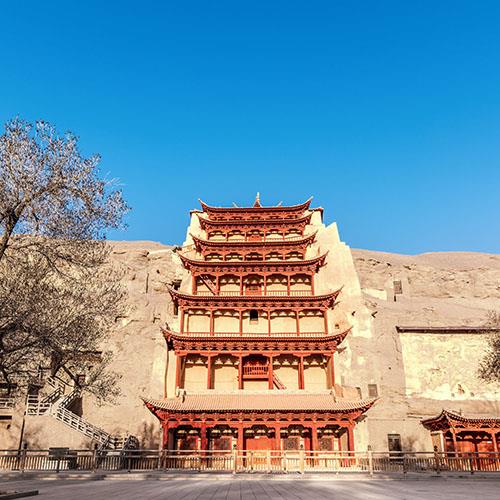
The Mogao Caves - Dunhuang
The Mogao Caves are a shrine of Buddhist art treasures located 15 miles from downtown Dunhuang on the eastern slope of Echoing-Sand Mountain. The caves were built in the year 366 AD, there is a network of plank reinforced roads that lead north to south and stretch for 5,249 feet leading to the caves openings. The caves are stacked five stories high some reaching up to 164 feet (Mogao means high up in the desert). The Mogao Caves are often referred to as the Caves of a Thousand Buddhas, Mogao sculptors improvised where the rock surface did not work well under their chisels, they placed statues in front of the cave walls, carved relief murals as backdrops, and painted the sidewalls and ceilings with art decors. The largest statue carved stands at 113 feet tall and the smallest is 0.79 inches. There are 735 caves, 45,000 square meters of murals, and 2,415 mud-colored sculptures, the Mogao Grottoes are the largest and best preserve treasure house of the Buddhist art world.

The Sichuan Giant Panda Sanctuaries - Sichuan province
The Sichuan Giant Panda Sanctuaries are home to over 30% of the world's panda population, classed as highly endangered with a massive area of land featuring seven nature reserves and nine scenic parks in the Qionglai and Jiajin Mountains. The world’s first giant panda was discovered in Baoxing county in the Sichuan province, it is the largest and most complete giant panda habitat in the world. There are other endangered species here such as red pandas, snow leopards, and clouded leopards. Outside the tropical rainforests, this area is among the botanically richest sites of any region in the world and home to between 5-6,000 species of flora. These sanctuaries have been listed as a UNESCO World Heritage Site since 2006 due to the biodiversity and conservation of the giant pandas. The sanctuaries are recognized as a “National Treasure” in the country and a flagship for global conservation efforts and the most important source of giant pandas for establishing the captive breeding population of the species.
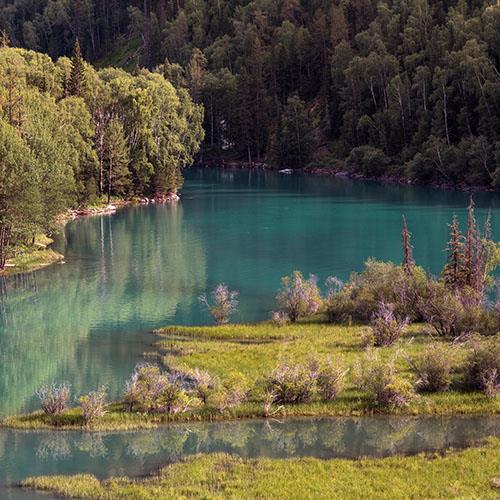
The Wolong National Reserve - Sichuan Province
The Wolong National Reserve is a protected area located in Wenchuan County, Sichuan Province, People’s Republic of China, it was established in 1963 and covers around 200,000 hectares. The Sichuan Provinces are home to the panda with an estimated 18 nature reserves for pandas, the Giant panda is a symbolic animal of the World Foundations for Wild Animal Protection. The Wolong Giant Panda Nature Reserve is a panda research center declared a UNESCO World Heritage Site in 2006. The reserve is home to 150 wild giant pandas and other endangered species like the snow leopards, red pandas, golden monkeys, white-lipped deer, and many precious plants. There is a large research laboratory and a Panda Hospital on site. There is also a large bamboo forest covering 680 acres and 3.10 miles of footpaths.
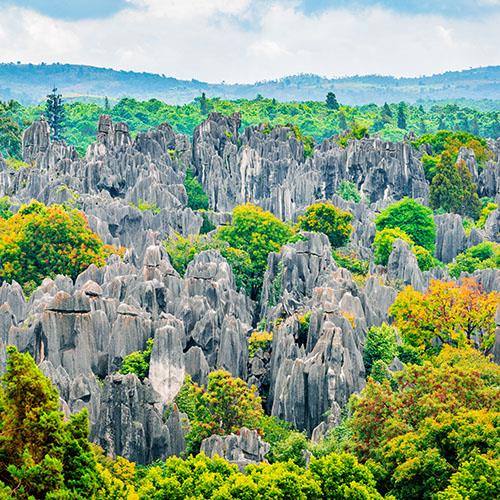
The Wulingyuan Scenic and Historic Interest Area - Hunan Province
The Wulingyuan Scenic and Historic Interest Area include Zhangjiajie National Forest Park, Suoxiyu Scenic Area, Tianzishan Scenic Area, and Yangjiajie Scenic Area. A spectacular area stretching for over 26,000 hectares in China’s Hunan Province, the site is dominated by 3,000 narrow sandstone pillars and peaks, that rise over 65 feet. It is like a natural maze, a geological museum, and forest kingdom, and garden of plants, and a paradise for wild animals. The area is recognized for its concentration of spectacular quartzite sandstone rock pinnacles and spires which are unlike anything else in the world. The landscapes are decorated with deep ravines and gorges with streams, pools, and waterfalls, forested hillsides, lakes, and some 49 limestone caves. The area is home to at least 3,000 plant species and a fauna that includes the Chinese giant salamander, Asiatic black bear, clouded leopard, and Chinese water deer that are globally threatened with extinction.
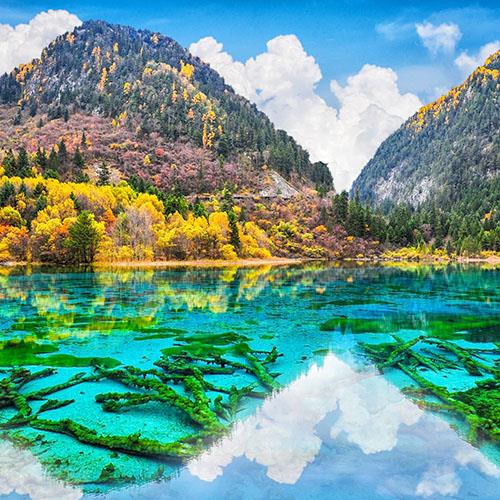
The Jiuzhaigou Valley Scenic and Historic Interest Area - Sichuan province
The Jiuzhaigou Valley Scenic and Historic Interest Area is an especially scenic area part of the Minshan Mountains on the edge of the Qinghai-Tibet plateau in the northern Sichuan province. It was the first nature reserve in China with its main purpose to protect the natural scenery, named after the nine Tibetan villages scattered throughout the area. It was inscribed by UNESCO World Heritage Site in 1992 and a World Biosphere Reserve in 1997. The Jiuzhaigou Valley stretches for over 72,000 hectares and reaches an altitude of more than 14,800 feet above sea level with a series of diverse forest ecosystems. There are many kinds of rare plants and animals, along with rich ancient fossils, glacial landforms, sputtering waterfalls, springs, and 108 colorful pools. Some 140 bird species inhabit the valley, along with several endangered plant and animal species that include the giant panda and the Sichuan takin. The area is a reserve of exceptional natural beauty filled with spectacular jagged alpine mountains that soar above coniferous forests around fairyland landscapes of crystal clear, strange colored blue, green and purplish pools, lakes, waterfalls, limestone terraces, caves, and other beautiful features. There are several karst formations, and the area is a “natural museum” for alpine karst hydrology and research.
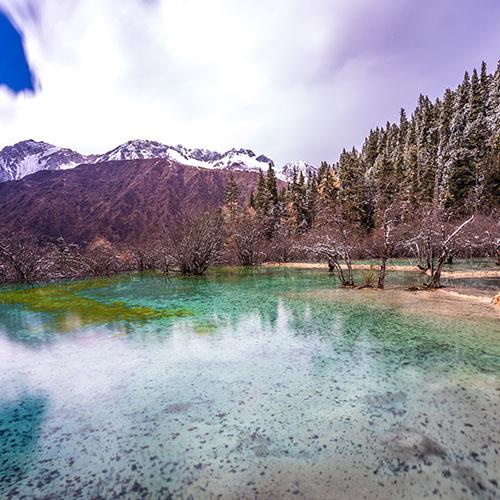
The Huang Long Scenic and Historic Interest Area - Sichuan Province
The Huang Long Scenic and Historic Interest Area, the Huanglong National Park is located in Songpan County of Aba, Sichuan Province. The area features large-scale and colorful calcified landscapes. The area features large-scale and colorful calcified landscapes it is renowned for its colorful pools, snow-capped mountains, deep canyons, verdant forests, flowing rivers, cascading waterfalls, hidden caves, ancient temples, and unique folk culture. The area earned itself the fame of “Heaven Lake” as well as the “Calcification Museum” as well as the “World Wonder” and “Fairy Land on Earth”. It was included on the UNESCO World Heritage list in 1992. The Huanglong National Park consists of Huanglong Valley, Danyu Gorge, Xuebao Peak, and Muigou Valley. The area has a population of endangered animals, including the giant panda and the Sichuan golden snub-nosed monkey.
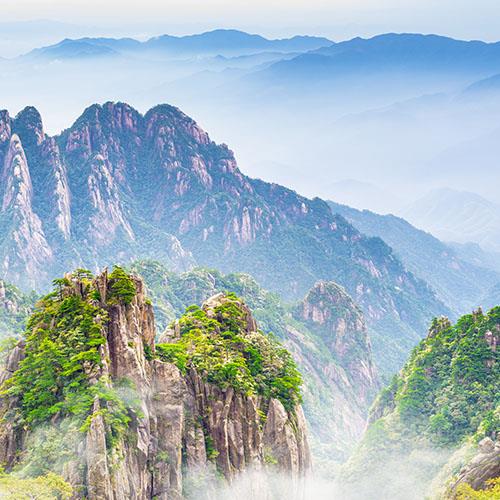
Mount Huangshan - Anhui Province
Mount Huangshan or Yellow Mountain is known as ‘the loveliest mountain of China’ formed nearly 100 million years ago. The mountain is well known for its four breathtaking wonders; odd pines, weird rocks, a sea of clouds, and hot springs. The mountain is fascinating for visitors, poets, painters, and photographers, the area is renowned for its magnificent natural scenery which is made up of granite peaks, and rocks that emerge out of the clouds. Huangshan played an important role in the history of Chinese art and literature since the Tang dynasty around the 8th century when a legend dating from the year 747 described the mountain as the place of discovery of the long-sought elixir of immortality. It has attracted many poets and celebrities who left a wealth of calligraphy and painting, literature, and legends. It also gave birth to the Huangshan painting style that created a large number of excellent works. The mountain is located in the humid subtropical monsoon climate zone of China’s Anhui Province in eastern China covering a massive area of land and known for its outstanding importance, botanical richness, and for the conservation of several locally or national endemic plant species, some of which are threatened with extinction. Huangshan is a UNESCO World Heritage Site and a major tourist attraction in China. Some of teh mountain peaks rise to 3,250 feet above sea level, the three tallest peaks are Lotus Peak, Bright Peak, and Celestial Peak.
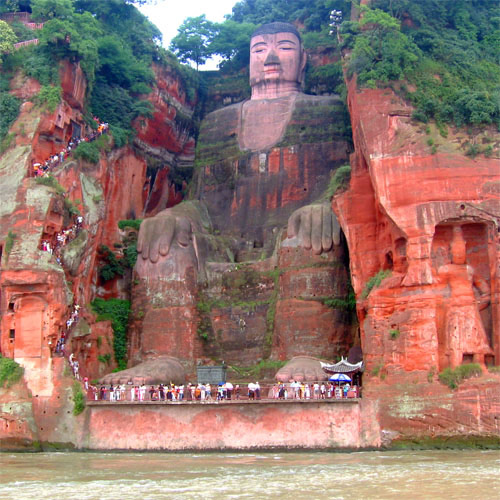
The Mount Emai Scenic Area - Sichuan province
The Mount Emai Scenic Area, which includes the Leshan Giant Buddha Scenic Area was listed as a UNESCO World Heritage Site in 1996. The 233 foot tall stone statue of Buddha was built between 713 and 803 during the Tang Dynasty, it is carved out of a cliff face of Cretaceous red bed sandstone which lies at the confluence of the Min River and Dadu River in the southern portion of the Sichuan province, near the city of Leshan. The statue faces Mount Emai and the rivers flow beneath its feet, it is the largest and tallest stone Buddha statue in the world. The Scenic Areas comprise the place where Buddhism was first established in China, it is an outstanding location for its plant species diversity. Mount Emai is the most outstanding Buddhist mountain in the country, and the site has been a sacred Buddhist site following the 6th-century visit of Bodhisattva Puxian and his six-tusked elephant. The mountain is covered in sub-tropical verdant forests where endemic and endangered plants grow including orchids, primulas, rhododendrons, camellias, ginkgos, cycads, and tree ferns. The mountain is also frequently covered in dense clouds that are associated with the high rainfall and humidity in the area.
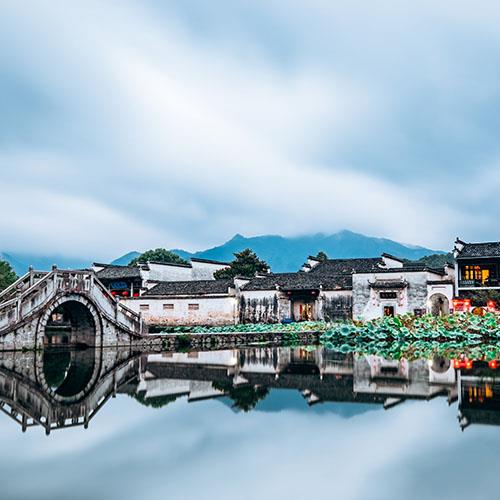
The ancient village of Hongcun in Hongcun Town
The ancient village of Hongcun in Hongcun Town, Yi County is located near the southwest slopes of Mount Huangshan. Together with the Xidi, the village was inscribed on the UNESCO World Heritage Site in 2000 due to its exceptional preservation of the architecture and city plan of a rural village in China. The village was the location for scenes from the famous Oscar film Crouching Tiger, Hidden Dragon. The 900-year-old village is called “the ancient village in Chinese paintings” is the best example of typical Anhui-style architecture. Such a quaint, quiet, and peaceful village is so picturesque constructed around two pools, with canals weaving throughout the town. The pools are lined by two-story buildings that are painted white with dark detailing and tiles. The surrounding countryside is simply breathtaking and well worth a walk with a noted bamboo grove within walking distance of the village.
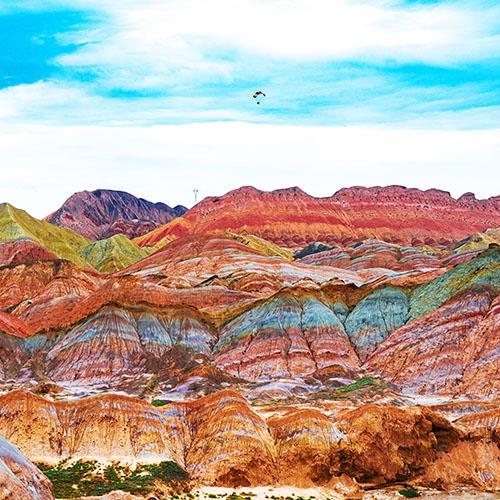
China Danxia - Multiple Destinations
China Danxia is a name given to a unique type of landscape developed on continental red terrigenous sedimentary beds influenced by endogenous forces and exogenous forces in China. The UNESCO World Heritage site of Danxia was inscribed on this list in 2010 and comprises six areas found in the subtropical zone of Southwest China and includes Chishui (Guizhou province), Training (Fujian province), Langshan Mountain (Hunan province), Danxai Mountain (Guangdong province), Longhu Mountain (Jiangxi province), and Jianglangshan Mountain (Zhejiang province). These areas are characterized by spectacular red cliffs and a range of erosional landforms that include dramatic natural pillars, towers, ravines, valleys, and waterfalls. The rugged landscapes in this area have helped to conserve sub-tropical broad-leaved evergreen forests, and host many species of flora and fauna, around 400 of which are considered rare or threatened. The dramatic scenery and natural beauty here include verdant forests, natural pillars, towers, deep ravines, valleys, and plunging waterfalls.
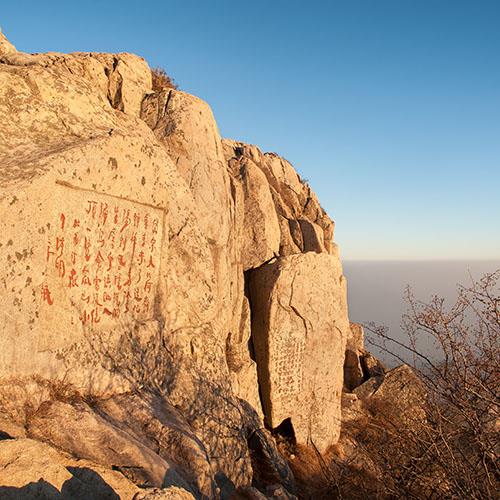
Mount Tai - Shandong province
Mount Tai (‘shan’ means mountain) is a famous and sacred mountain in China that was the object of an imperial cult for almost 2,000 years. The artistic masterpieces found on the mountain are in perfect harmony with the natural landscapes. The mountain was settled by humans as early as the Neolithic and has been worshipped for the last three millennia, and inspiration to Chinese artists and scholars that symbolize ancient Chinese civilizations and beliefs. The mountain is home to a large and impressive rock mass that covers 25,000 hectares and soars to 5.068 feet above the surrounding plateau. There are 12 historically recorded imperial ceremonies held on the mountain in homage to Heaven and Earth, along with 1,800 stone tablets and inscriptions, and 22 temples, the mountain is a world-renowned treasure house of history and culture.
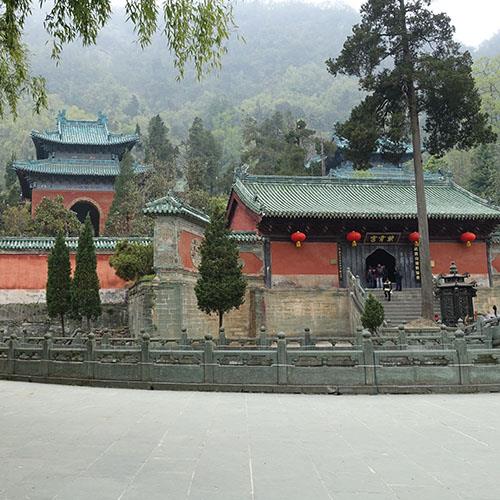
The Ancient Building Complex - Wudang Mountains
The Ancient Building Complex is located amongst the peaks, ravines, and gullies of the picturesque Wudang Mountains where palaces and temples are found and form the nucleus of this group of secular and religious buildings. The site was built as an organized complex during the Ming dynasty during the 14-17th centuries and has been a Taoist center from the early Tang Dynasty, it represents the highest standards of Chinese art and architecture with a period of almost 1,000 years. The Ancient Building Complex consists of 9 palaces, 9 monasteries, 36 nunneries, and 72 temples that follow the major building campaign that was undertaken by Emperor Zhu Di to align his imperial regime with Taoism. Today there are 53 buildings and 9 archaeological sites that remain and include the Golden Shrine and the Ancient Bronze Shrine, the stone-walled Forbidden City of 1419, Purple Heaven Palace, the Nanyang Palace, the Fuzhen Temple, and the stone Zhishi-Xuanyue Gateway.
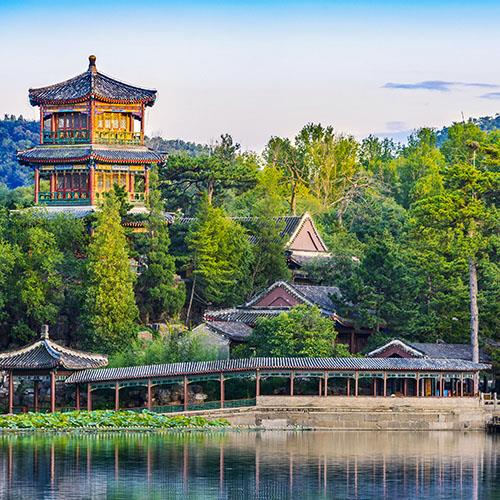
The Mountain Resort in Chengde - Chengde
The Mountain Resort and the Qing Dynasty’s summer place is located in Chengde and was built between 1703 and 1792. The vast complex is filled with imperial palaces, administrative and ceremonial buildings, and gardens with various architectural styles that blend harmoniously with the surrounding landscapes which feature lakes, pastureland, and verdant forests. The resort is frequently used and has a vast and rich collection of Chinese landscapes and architecture with a culmination of colorful gardens, charming pagodas, stunning temples, and beautiful palaces from various regions in China. The site was awarded as a UNESCO World Heritage Site in 1994. Chengde is a classic masterpiece of Chinese palace architecture, gardening art, and religious architecture. The resort is designed to follow the topography of the area filled with natural hills and water, it inherits and carries forward China’s imperial gardening tradition and integrates elements of Han, Mongolian, and Tibetan architectural art.
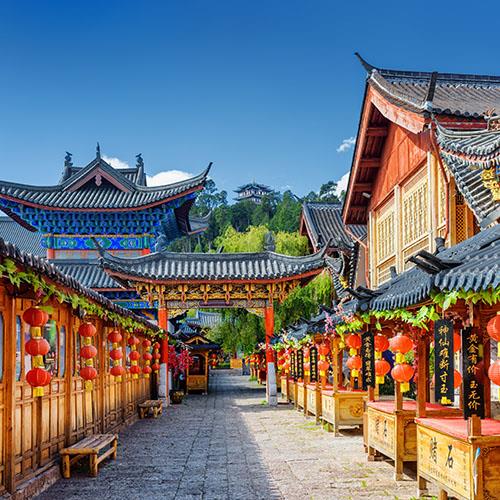
The Ancient Town of Lijian - Yunnan
Lijian is an ancient town located on the Lijian plain situated at 7.874 feet above sea level in southwest Yunnan, China. The town is perfectly adapted to the uneven topography and has retained a historic townscape of high quality and authenticity. The town’s historic architecture is noteworthy for the blending of elements from several cultures that have blended over many centuries. There are a series of strategic passes that allow access through the surrounding mountains. Yulong Snow Mount is the northwest source of the rivers and springs that water the surrounding plain and supply the Heilong Pool (Black Dragon Pond). The town also possesses an ancient water supply system of great complexity and ingenuity which is still functioning today. Lijiang comprises three parts including Dayan Old Town, Baisha, and the Shuhe housing clusters.
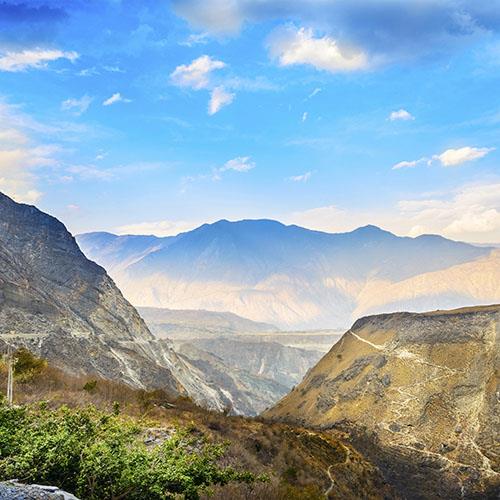
The Three Parallel Rivers of Yunnan Protected Areas - Yunnan Province
The Three Parallel Rivers of Yunnan Protected Areas are located in the mountainous region of the Yunnan Province in China. A natural serial property that consists of 15 protected areas grouped into eight geographical clusters within the boundaries of the Three Parallel Rivers National Park covering 1.7 million hectares and features sections of the upper reaches of three of the great rivers in all of Asia; the Yangtze (Jinsha), Mekong, and the Salween that run parallel north to south through steep gorges that in some areas are almost a 1,000 feet deep and bordered by glaciated peaks that rise to almost 20,000 feet. The region is one of the richest temperate regions in the world in terms of biodiversity.
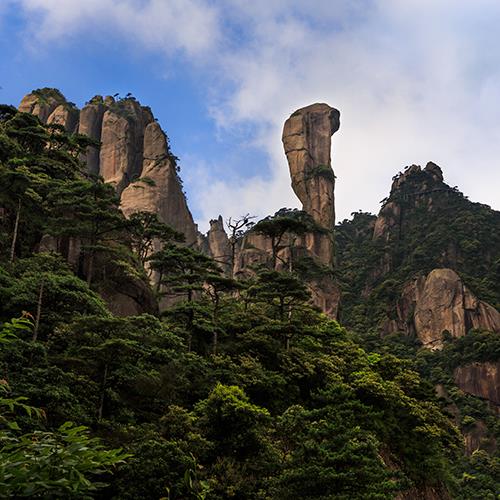
Mount Sanqingshan National Park - Jiangxi Province
Mount Sanqingshan National Park covers a large area of the property in the west of the Huyaiyu mountain range, northeast of Jiangxi Province in the east of central China. The park was inscribed on the UNESCO World Heritage Site for its exceptional scenic quality, with a concentration of fantastically shaped pillars and peaks, 48 granite peaks, and 89 granite pillars many resembling human or animal silhouettes. The mountain rises 5,961 feet above sea level and is filled with exceptional beauty with vegetation and other arresting landscapes with bright halos on clouds and white rainbows. The area is a combination of subtropical monsoonal and maritime influences forming an island of temperate forest above the subtropical landscape. There are verdant forests, numerous cascading waterfalls, lakes, and springs.
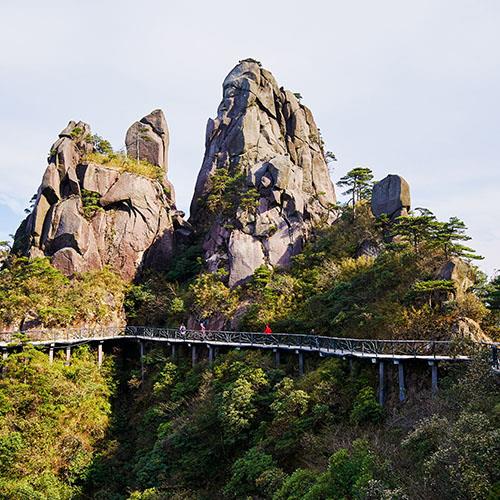
Mount Songshan - Dengfeng
Mount Songshan located in Dengfeng is one of the most sacred mountains in the country, renowned as a spiritual center in China and home to various religious institutions and famous temples like the Taoist Zhongyue Temple, the Buddhist Shaolin Temple, the Confucian Songyan Academy, and Gaocheng Observatory. “The Center of heaven and earth” is the poetic expression derived from Chinese literature for the mountain which was inscribed on the UNESCO World Heritage Site list in 2010. Mount Songshan reaches 4,921 feet, Dengfeng is the town at the foothills of the mountain which features some of the best examples of ancient Chinese buildings devoted to ritual, science, technology, and education.
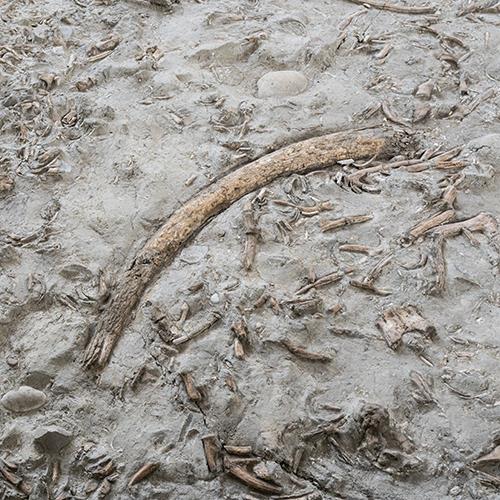
Chengjiang Fossil Site - Yunnan province
Chengjiang’s fossils are located in a hilly region in the Yunnan province of China, and display the most complete record of an early Cambrian marine community with exceptionally preserved biota, displaying the anatomy of hard and soft tissues in a very wide variety of organisms, invertebrate, and vertebrate. These fossil remains are of exceptional significance and present an outstanding and extraordinarily preserved record that testifies to the rapid diversification of life on Earth during the Cambrian Period 530 million years ago.
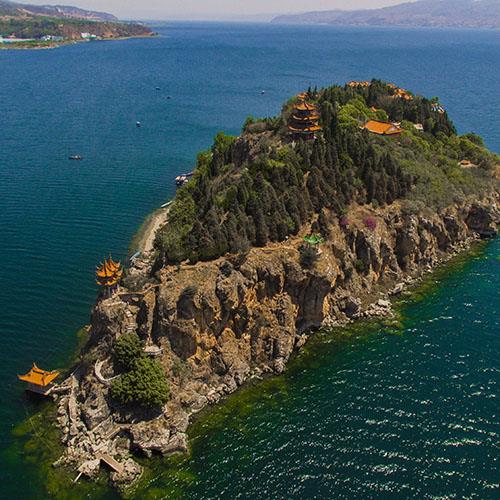
Fuxian Lake - Chengjiang
Fuxian Lake stretches through Chengjiang, Jiangchuan, and Huaning Counties in the Yunnan Province spanning an area of 212 square kilometers. The lake is ranked as the third-largest lake in Yunnan, after Dian Lake, and Erhai Lake and is the deepest lake in Yunnan at 508 feet deep. It is also the third deepest freshwater lake in the country.
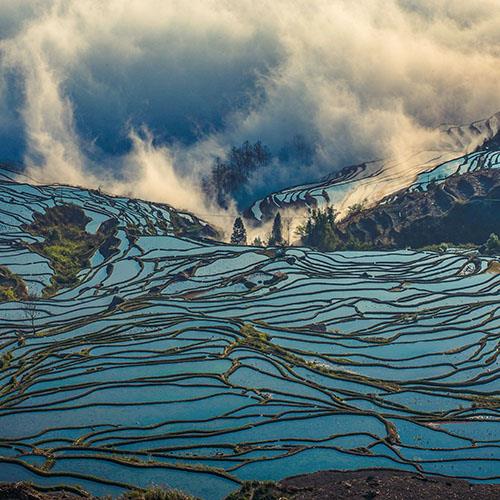
The Cultural Landscapes of Honghe Hani Rice Terraces - Southern Yunnan
The Cultural Landscapes of Honghe Hani Rice Terraces cover over 16,000 hectares in Southern Yunnan, China. The landscapes are blanketed in spectacular verdant terraces cascading down the slopes of the towering Ailao Mountains to the banks of the Hong River. Carved out of the dense verdant forest over the past 1,300 years by Hani people that migrated here, and developed a complex system of channels to bring water from the forested mountaintops to the terraces. There is an integrated farming system that involves buffalos, cattle, ducks, fish, and eel and supports the production of red rice, which is the primary crop of the area. The inhabitants here worship the sun, moon, mountains, rivers, forests, and other natural phenomena including fire. In some places, there are as many as 3,000 terraces between the lower edges of the forest and the valley floor.
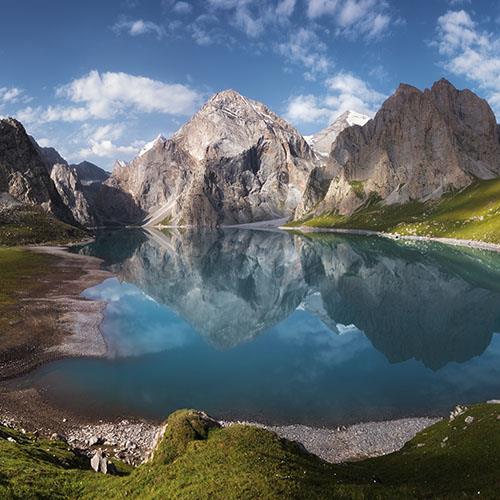
Xinjiang Tianshan
Xinjiang Tianshan comprises four components; Tomur, Kalajun-Kuerdening, Bayinbukuke, and Bogda covering a total of over 600,000 hectares. Part of the Tianshan mountain system in Central Asia, which is one of the largest mountain ranges in the entire world. Xinjiang Tianshan presents unique physical geographic features and scenically beautiful areas that include snow and snow-capped mountains, glacier-capped peaks, forests, meadows, clear rivers, lakes, and red bed canyons. The site extends to the Taklimakan Desert, one of the largest and highest deserts in the world, which is known for its large dune forms and great dust storms. Xinjiang Tianshan is also an outstanding example of the ongoing biological and ecological evolutionary process in a temperate arid zone.
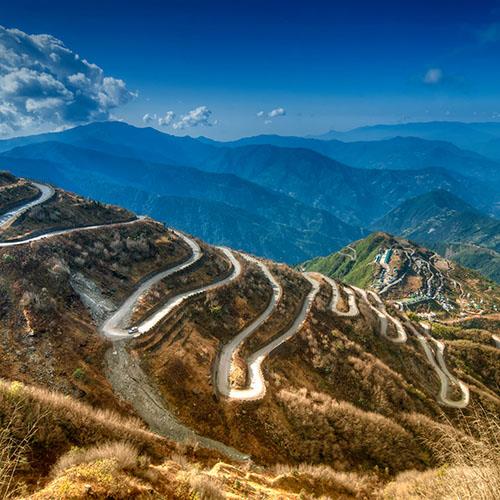
The Silk Roads: The Routes Network of Chang’an-Tian Shan Corridor - Chang’an to Luoyang
The Silk Roads: The Routes Network of Chang’an-Tian Shan Corridor is a UNESCO World Heritage Site that covers the Chang’an-Tianshan portion of the ancient Silk Road network from Central China to the Zhetysu region of Central Asia. This section of the extensive Silk Road network stretches for 3,106 miles from Chang’an to Luoyang, it took shape between the 2nd century BC and 1st century AD and remained in use until the 16th century. The 33 components included in the routes network include capital cities, palace complexes, trading settlements, Buddhist cave temples, ancient paths, posthouses, passes, beacon towers, sections of The Great Wall, fortifications, tombs, and religious buildings. The routes served as a way to transfer raw materials, foodstuffs, and luxury goods such as silk over vast distances, by pack animals and river craft.
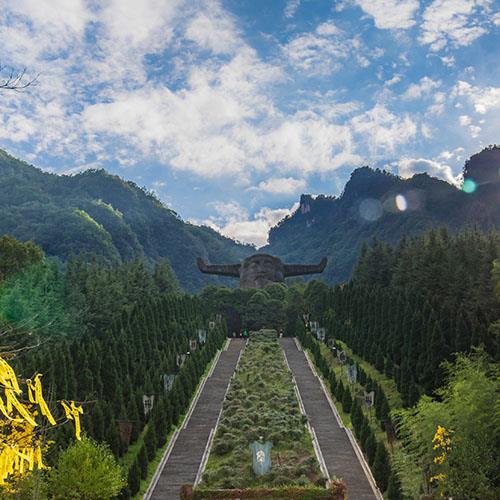
The Hubei Shennongjia - Shennongjia Forestry District
The Hubei Shennongjia is located in the Shennongjia Forestry District and Badong County in China’s Hubei Province. It consists of two components and protects the largest primary forests remaining in Central China, providing habitats for many rare animal species like the Chinese Giant Salamander, the Golden or Sichuan Snub-nosed Monkey, the Clouded Leopard, the Common Leopard, and the Asian Black Bear. The site covers almost 80,000 hectares and is one of the three centers of biodiversity in China, situated along a zone of climate transition, where the climate shifts from the subtropical zone to the warm temperate zone, where warm and cold air masses from north and south meet and are controlled by the Subtropical Gyre. There are 11 types of vegetation characterized by a diversity of altitudinal gradients and is considered to be one of the three centers of endemic plant species in the country. Among the fauna in the region, there are over 600 vertebrate species including 92 mammals, 399 birds, 55 fish, 53 reptiles, and 37 amphibian species as well as 4,365 insect species.