


Destinations
❮Main Menu
UNESCO WORLD HERITAGE SITES IN SWITZERLAND

Abbey of St Gall (1983), St. Gallen
The Convent of St Gall, a perfect example of a great Carolingian monastery, was one of the most important spiritual centers of Europe. And the spirit of the Benedictine monks can still be felt here today as you enter the Abbey District of St. Gallen. Its library is one of the richest and oldest in the world and contains remarkable manuscripts such as the earliest-known architectural plan drawn on parchment. The cathedral and the library are the main features of this stunning architectural complex, reflecting 12 centuries of continuous activity. It was designated a UNESCO World Heritage site in 1983.

Benedictine Convent of St John at Müstair (1983), Swiss Alps
The Abbey of Saint John at Müstair, located in the village of Müstair in Canton Graubünden, is an early medieval Benedictine monastery dating to the late 8th century CE that became an abbey in 1163 CE. It is a great example of Christian monastic renovation during the Carolingian period. The Convent is renowned across Europe and the world for its beautiful, well-preserved medieval design and decor. For over 1200 years, the Abbey and Saint John at Müstair has remained a Benedictine religious community. It is also home to Switzerland’s greatest series of figurative murals, along with Romanesque frescoes and stuccoes.

Lavaux, Vineyard Terraces (2007)
The Lavaux Vineyard Terraces, spread across 19 miles along the south-facing northern shores of Lake Geneva from the Chateau de Chillon to the eastern outskirts of Lausanne in the Vaud region, cover the lower slopes of the mountainside between the villages and the lake. These are some of the most beautiful vineyards in Switzerland. The vine terraces can be traced back to the 11th century, when Benedictine and Cistercian monasteries controlled the area. It is a remarkable example of a centuries-long collaboration between people and their environment, developed to optimize local resources to produce high quality wine that has always been an important part of the economy.
Explore the vineyards starting from Chexbres, Saint-Saphorin, Rivaz or Epesses. Wherever you decide to start you can enjoy the many vineyard cellars dotted throughout your route. Thanks to the railway line running along Lake Geneva, you can shorten the loop by taking the train from Saint-Saphorin, Rivaz or Epesses.

Old City of Berne (1983)
Listed as a UNESCO World Heritage site since 1983, the Old City of Berne boasts quaint alleys and so much charm. The town was founded in the 12th century on a hill site surrounded by the Aare River. The buildings in the Old City date back to a variety of periods. Most of the medieval town was restored in the 18th century but it has retained its original character.

Prehistoric Pile Dwellings Around The Alps (2011)
Nine pile dwellings are located on the shores of Lake Constance in Baden-Württemberg. Nine more are listed in Upper Swabia, south of Augsburg and at Lake Starnberg. Together with 93 further sites in France, Italy, Austria, Switzerland and Slovenia, they represent an archaeological legacy that dates back almost 7,000 years. These prehistoric settlements (pile dwellings) are all located in lakes and marshes around the Alps. Out of the 111 small dwellings, 56 of them are located in Switzerland. The artifacts (organic materials such as wood, textiles, plant remains and bones provide remarkable insights into life around 5,000 to 500 B.C.). Many finds are not visible or accessible as they are underwater. The settlements in Switzerland are exceptionally well-preserved and culturally rich archaeological sites, which constitute one of the most important sources for the study of early agrarian societies in the region.

Rhaetian Railway in the Albula / Bernina Landscapes (2008)
Rhaetian Railway in the Albula/Bernina Landscapes was added to the UNESCO World Heritage list in July of 2008. It is the only third railway in the world to be considered “universally outstanding” by UNESCO. The railway brings together two historic lines that harmoniously cross the Swiss Alps through two passes into charming landscapes with striking constructions such as viaducts and spiral tunnels. It is considered a masterwork that developed through the synergy of politics, the economy, technology, culture and nature. The lines are open access to culturally significant historic sites. Over 75 beautiful miles from Thusis via St. Moritz to Tirano, the line crosses 196 bridges, goes through 55 tunnels and passes through 20 towns and villages. The railway infrastructure, which is now about 100 years old, is still authentic and in good condition.

Monte San Giorgio (2003)
Monte San Giorgio is a pyramid-shaped, wooded mountain beside Lake Lugano. It has a truly rich inner life, rising around 3,600 ft. in height, the Monte San Giorgio is regarded as the best fossil record of marine life from the Triassic Period, and a UNESCO World Heritage site since 2003. Thousands of fossilised fish and marine saurians of 20 ft in length have already been unearthed here by eager scientists. Over 230 million years ago, this was the site of the 330-ft-deep ocean basin. Because the lagoon was near land, the remains also include land-based fossils of reptiles, insects and plants, resulting in an extremely rich source of fossils. Today, at the southern end of Lake Lugano, the Monte San Giorgio rises like a pyramid, filled inside with all manner of fossils. Stroll the vineyards along the southern slopes of the woody mountain, explore the charming town of Meride, or relax in the grottos of the Mendrisiotto region.
ADDITIONAL UNESCO WORLD HERITAGE SITES IN SWITZERLAND
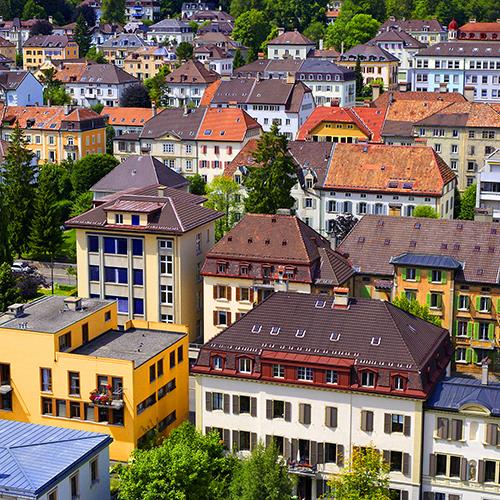
La Chaux-de-Fonds / Le Locle, Watchmaking Town Planning (2009)
The two towns of Le Locle and La Chaux-de-Fonds were built by and for the watchmaking industry. The towns sit close to one another in a remote area in the Swiss Jura mountains, on land ill-suited to farming. Built in the early 19th century, after extensive fires, the towns owed their existence to the watchmaking industry. Their layout along an open-ended scheme of parallel strips on which residential housing and workshops are intermingled reflects the needs of the local watchmaking culture that dates back to the 17th century and is still alive today. The urban layout of both towns has accommodated the transition from the artisanal production of a cottage industry to the more concentrated factory production of the late 19th and 20th centuries. The town of La Chaux-de-Fonds was described by Karl Marx as a “huge factory-town” in Das Kapital where he analyzed the division of labor in the watchmaking industry of the Jura.
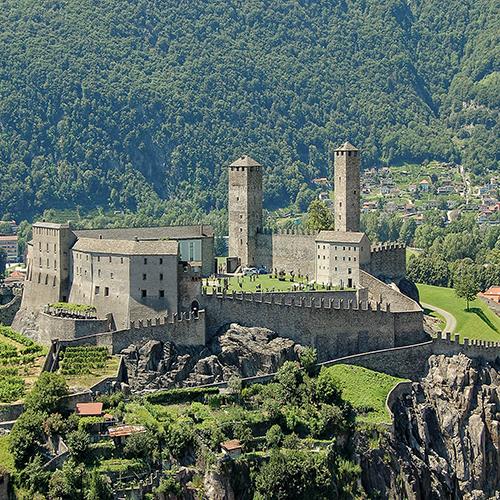
Three Castles, Defensive Wall, and Ramparts of the Market-Town of Bellinzona (2000)
The Bellinzona site consists of a group of fortifications grouped around the castle of Castelgrande, which stands on a rocky peak looking out over the entire Ticino valley. The three castles of Bellinzona are among the most remarkable examples of medieval military architecture. They were built by the Dukes of Milan to bar the route southwards to the Swiss. Over the course of the centuries, the three castles of Castelgrande, Montebello and Sasso Corbaro have been reconstructed and restored several times. With its walls, towers, battlements and gates, this magnificent defensive complex remains a source of wonder to those who visit today.

Swiss Alps Jungfrau-Aletsch (2001)
The Jungfrau-Aletsch Region, inscribed in 2001 as a UNESCO World Natural Heritage Site. The site has expanded since its designation both to the east and west, bringing the surface area 318 square miles. At its heart lies the mighty rock massif of the Eiger, Monch and Jangfrau and the glacial landscape around the Great Aletsch Glacier, the longest glacier in the Alps, with a length of 14 miles. To cross the Aletsch Glacier is to take a remarkable journey into a stunning world of ice and rocks, Alpine flowers and forests. The site provides a beautiful example of the formation of the High Alps, including the most glaciated part of the mountain range. It boasts a wide diversity of ecosystems and provides both beauty and a wealth of information that is invaluable in terms of the ecological and biological processes it illustrates, notably through plan successions. The land has played a significant role in European art, literature, mountaineering and alpine tourism.

Swiss Tectonic Arena Sardona (2008)
The stunning Swiss Tectonic Arena Sardona in the eastern Alps is a striking mountain landscape where peaks of ancient dark-colored rock are clearly seen to overlie lighter rocks some 150-250 million years younger. The area is an example of mountain building through tectonic thrust, and historically important as the classical locus of nappe theory and thrust tectonics which underlay Wegener’s theories of continental drift and plate tectonics. The site is distinguished by the clar three-dimensional exposure of the structures and processes that characterize this phenomenon and has been a key site for the geological sciences since the 18th-century. The Glarus Alps are glaciated mountains rising dramatically above narrow river valleys and are the site of the largest post-glacial landslide in the Central Alpine region.