


Destinations
❮Main Menu
UNESCO WORLD HERITAGE SITES IN MOROCCO

Archaeological Site of Volubilis
The Archaeological Site of Volubilis is a UNESCO World Heritage Site located about 20 miles north of Meknes. This ancient city was founded in the 3rd century B.C., it is the Mauritanian capital and became an important outpost of the Roman Empire. The site is graced with many fine ancient buildings that have extensive remains located in a fertile agricultural area. It was occupied by the Romans for three centuries, they expanded the site further, and it was finally then the capital of the Emirate of Morocco for three centuries. There are large portions of the ruins still visible today.
Historic City of Meknes
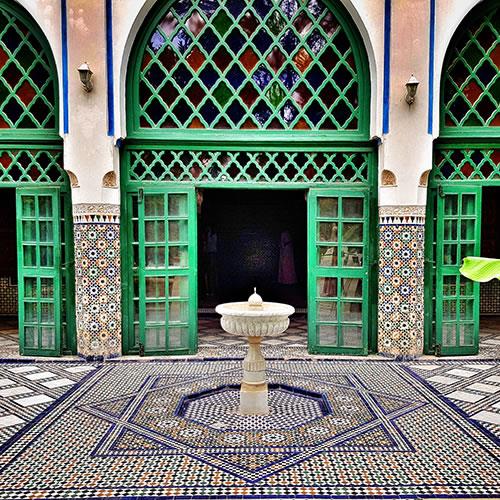
The Historic City of Meknes was founded in the 11th century by the Almoravids as a military settlement, it became the capital under Sultan Moulay Ismail (1672-1727), the founder of the Alawite dynasty. Meknes is one of the four imperial capitals of Morrocco, located approximately 40 miles west-southwest of another imperial capital, Fez. The sultan turned it into an impressive city in Spanich-Moorish style, it was surrounded by high walls with great doors blending Islamic and European styles of the 17th century Maghreb that are still an event today. Visiting the expansive Dar al-Makhzen (the Royal Palace), or the colorful and ornate mausoleum where he is interred. Meknes is a living museum dedicated to the city’s golden era, it is one of Morocco’s UNESCO World Heritage sites.

Ksar of Ait-Ben-Haddou
Ksar of Ait-Ben-Haddou Ait Benhaddou is a ksar, or a fortified village built entirely out of native earthen clay, that was one of the key links on the trans-Saharan trade route from Marrakech. The buildings are surrounded by high walls, in a traditional pre-Saharan habitat established in the 11th century due to its strategic location on a hillside next to the Ounila River. There are houses that are crowded together within the defensive walls, reinforced with corner towers. It once housed everyone who lived in the area, the ksar is still home to a few families now, and most townspeople live in the valley. The ksar is a striking example of the architecture of Southern Morocco and is a UNESCO World Heritage Site today, where visitors can experience an authentic Berber life.

Medina of Essaouira
The Medina of Essaouira is an exceptional example of a late 18th-century fortified town that was built according to the principles of contemporary European military architecture in a North African context. It was formerly the Portuguese colony of Mogador, situated on Morocco’s Atlantic coast, the old town is perched high on a clifftop protected by ramparts along the coast. The town thrived in the 18th and 19th centuries when it became Morocco’s first world-class seaport and a major international trading seaport that links Morocco and its Saharan hinterland with Europe and the rest of the world. The sea is still important to the city’s economy today. There are some beautiful beaches here for sunbathers to professional surfers, it is well known for its “hippie culture”, and popularized as a result of Jimi Hendrix’s 1969 visit to the area. It is one of Morocco's UNESCO World Heritage Sites.

Medina of Fez
The Medina of Fez was founded in the 9th century and reached its height in the 13th-14th centuries under the Marinids, when it replaced Marrakesh as the capital of the kingdom. Fez is most famous for its ancient walled city, often compared to the walled city of Jerusalem. The old city of Fez has been declared a UNESCO World Heritage site. The immense Medina of Fes-I-Bali (the old city) is a massive labyrinth of monuments including madrasas, fondouks, palaces, residences, mosques, markets, and fountains. Three stunning buildings in the Medina include the Medersa Attarine, the Medersa Cherratine, and Medersa Seffarine, located near the center of the maze. Fez has retained its status as the country’s cultural and spiritual center. There are breathtaking views from the surrounding hills where two fortresses overlook the old city and the Borj Nord which contains an armaments museum.

Medina of Tetouan
The Medina of Tetouan is located in northern Morocco, it is one of the Kingdom’s two major Mediterranean ports. It was of particular importance in the Islamic period from the 8th century onwards, since it served as the main point of contact between Morocco and Andalusia. Nicknamed the “white dove” from all its whitewashed buildings. The Medina is a UNESCO World Heritage Site, a showcase of Andalusian and colonial Spanish influence and opulence. Tetouan was the capital of the Spanish protectorate in Morocco for nearly a century until the country regained its independence in 1956. The town is well illustrated by high-quality art and architecture that reveal clear Andalusian influences. Tetouan is the smallest of the Moroccan medinas yet unquestionably the most complete and has been largely untouched by subsequent outside influences.

Portuguese City of Mazagan
The Portuguese fortification of Mazagan is now part of the beautiful city of El Jadida located on the Atlantic coast of Morocco. It was founded during the 16th century by the Portuguese and served as a trading post on the exploration route to India. The fortified colony was taken over by the Moroccans in 1769, the fortifications include bastions, and ramparts that are an early example of Renaissance military design. The fort here is one of the best preserved of the European forts that are still standing in Morocco. The Old Town was the nucleus of the Portuguese settlement of Mazagan, it is filled with noteworthy sights and is a UNESCO World Heritage Site. Surviving Portuguese buildings in the Medina include the Cistern and the Church of the Assumption built in the Manueline style of late Gothic architecture. The city is an outstanding example of the interchange of influences between European and Moroccan cultures which is well reflected in the architecture, technology, and town planning.
Rabat, Modern Capital, and Historic City: a Shared Heritage
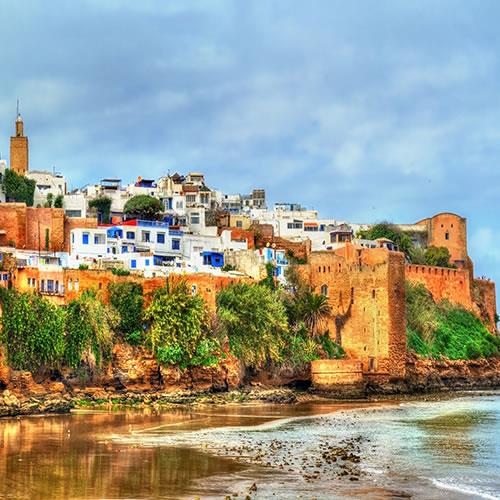
Rabat is one of the four imperial capitals of Morocco located on the Atlantic coast in the northwest portion of the country. The site is the product of a fertile exchange between the Arabo-Muslim past and Western modernism. Rabat is the Kingdom of Morocco’s current capital, built on a cliff overlooking the Atlantic coast, the Bou Regreg River separates Rabat from its sister city on the other bank, Sale. Notable sights in Rabat include the Royal Palace, the primary residence of King Mohammed VI and Princess Lalla Salma, Hassan Tower, a solitary minaret built in the 12th century for a mosque that was never completed, the Old Town, comprised largely of a cliffside fortress called the Kasbah of the Udayas, which is a UNESCO World Heritage Site, and the Necropolis of Chella, built by the Phoenician during the 3rd century BCE. The Jardins d’Essais botanical and pleasure gardens are worth a visit.