


UNESCO WORLD HERITAGE SITES IN SCOTLAND
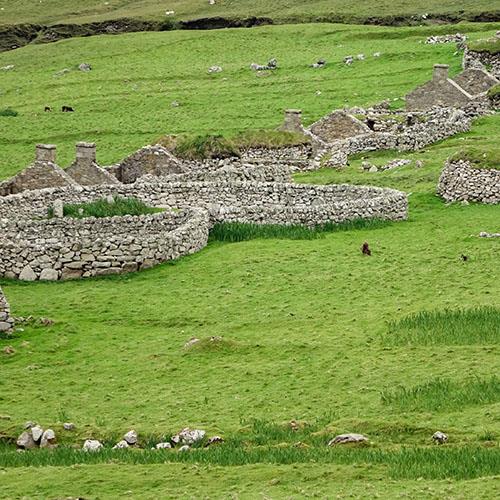
St Kilda
St Kilda is a group of remote islands and sea stacks situated 100 miles off the west coast of Scotland. The five islands that make up this unique archipelago include; Hirta, Soay, Boreray, Dun, and Levnish in the North Atlantic, they are part of the UNESCO World Heritage Sites of Scotland with a mixture of cultural and natural qualities. The islands feature spectacular landscapes that include vertical cliffs, and sea stacks that surround Village Bay. They are home to the largest colony of seabirds in Europe as well as unique populations of sheep, field mice, and wrens. The last residents of St Kilda were evacuated in 1930 after some 4,000 years of human habitation. The islands had survived what appears to be a very harsh environment by catching seabirds for food, feathers, oils, farming crops, and raising livestock. The clear oceanic waters here support a diverse range of flora and fauna.

The Old and New Towns of Edinburgh
The Old and New Towns of Edinburgh lie in the heart of Scotland, on the southern shores of the Firth of Forth. The city was originally founded on and around Castle Rock. These towns are amongst some of the most beautiful cityscapes in the world, with unique characteristics that come from the contrast between the medieval Old Town, with its pattern of distinctive narrow passageways, and the 18th-century New Town, which is the best-preserved example of Georgian town planning in the UK. Edinburgh the capital of Scotland for over 500 years is built on an extraordinary landscape of hills and valleys that formed millions of years ago by volcanoes and ice sheets. The towns are recognized as UNESCO World Heritage Site in Scotland, both towns contain many significant historic buildings, and more than 75% of all the buildings within the World Heritage Site are listed for their architectural and historical significance.
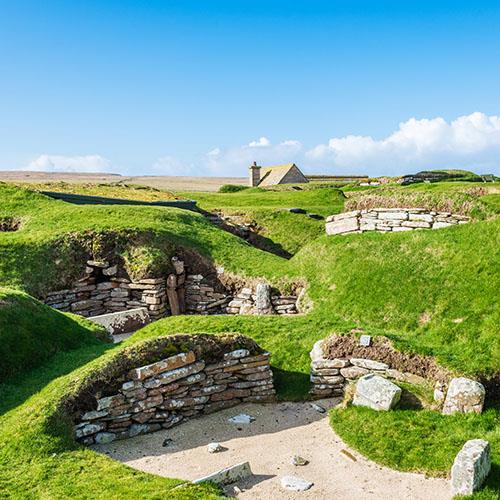
The Heart of Neolithic Orkney
The Heart of Neolithic Orkney is located near Stromness on the island of Mainland, Orkney. The four Heart of Neolithic Orkney sites include; Skara Brae, Maeshowe, the Stones of Stenness, and the Ring of Brodgar together make up one of the riches surviving Neolithic landscapes in Western Europe. Over 5,000 years ago, the prehistoric people of the Orkney Islands began to build extraordinary monuments out of stone, they are masterpieces of Neolithic design and construction. Together they give exceptional insights into the society, skills, and spiritual beliefs of the people who built them. These important domestic and ritual monuments give incredible insights into the society, skills, and spiritual beliefs of the people who built the monuments. Skara Brae is a domestic settlement with stone walls, passageways, and stone furnishings that include beds, and dressers. Maeshowe is a chambered tomb that is an extraordinary example of Neolithic architectural genius. It was designed so that the light of the settling sun at the winter solstice focuses on the narrow passageway illuminating the chamber inside. The Stones of Stennes circle and henge is a very early example of this type of monument, the surviving stones are enormous and stand 20 feet tall. The Ring of Brodgar is a great stone circle 426 feet across, it is surrounded by a rock-cut ditch, set in a spectacular natural amphitheater of lochs and hills.
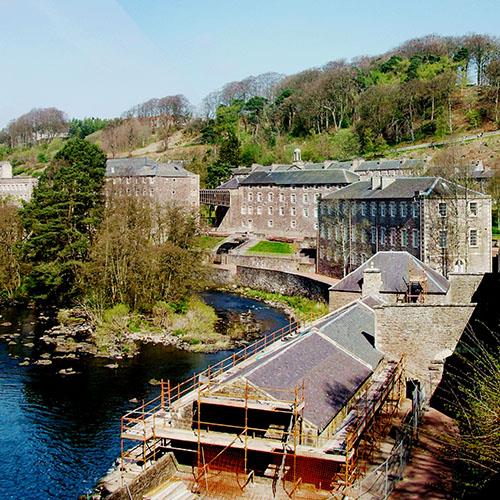
New Lanark
New Lanark is a restored 18th-century cotton mill village situated in the narrow gorge of the River Clyde in southern central Scotland, near the market town of Lanark. New Lanark was created as a cotton spinning village in the late 18th to early 19th century, by 1799 it was the biggest cotton mill in Scotland and formed one of the largest factory sites in the world. Robert Owen, a social pioneer who was renowned for his enlightened management of the mill, Owen transformed the mill under his management. He improved the conditions, facilities, and services for the workers and their families which influenced many social improvements. Over 2,000 people lived and/or worked in the village, and the mill continued to manufacture cotton for over 200 years, until 1968.
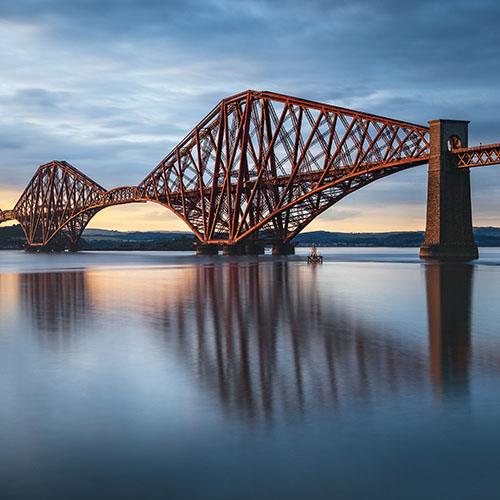
The Forth Bridge
The Forth Bridge is a 1.55 mile, 360-foot-high cantilever bridge linking Edinburgh and the Lothians in the south with Fife, and the Highlands in the north. The building of this masterpiece bridge of human creative genius conquered a natural barrier of a scale and depth that had never been achieved by humans. The Forth Bridge stretches across the estuary of the River Forth, with its innovative design, materials, and scale it achieves tremendous grace for something so solid. It was designed by English engineers Sir John Fowler, and Sir Benjamin Baker, and it was constructed by William Arrol of Glasgow. The bridge was completed in 1890 and was the longest cantilever bridge span in the world, holding this title for 27 years. It was the world’s first major steel structure representative of a landmark event in the application of science to architecture. The bridge today is a major rail crossing and still carries over 200 trains per day, it was restored in 2011 and is a UNESCO World Heritage Site in Scotland.
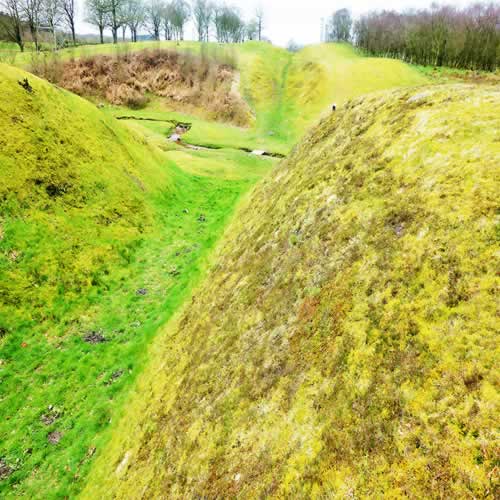
The Antonine Wall
The Antonine Wall runs across central Scotland, from Old Kilpatrick in the west to Bo’ness in the east. It marks the most northerly, and most complex frontier of the Roman Empire over 2,000 years ago, and was built by Roman soldiers for Emperor Antoninus Pius around AD 142. It was occupied for around a generation and then abandoned in the AD 160s, the wall was used as a physical barrier, and as a symbol of the Roman Empire’s power and control. The Antonine Wall was a turf rampart fronted by a wide and deep ditch with forts and fortlets along the wall that housed the troops who were stationed there. It also aced as a secure crossing point to control movement north and south. A road known as the Military Way ran behind the rampart, liking the forts.