


Destinations
❮Main Menu
EAST OF GRANADA
Guadix
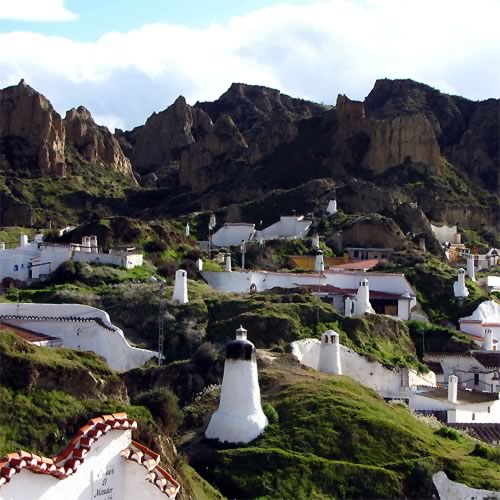
The most interesting town in this region is the town of Guadix, famous throughout Spain for its numerous cave dwellings, burrowed into the town's soft, sandy cliffs of tufa, and housing almost half of Guadix's population. It also has an impressive Gothic cathedral and a Moorish citadel. Its history dates back to Phoenician and Roman times, and it played a major role in the Reconquest.
The most interesting feature of the Guadix area is that almost half of the inhabitants of this large town live underground, in the southern part of the town, in what is known as cave houses. The jagged ochre terrain and the dazzling whitewashed chimneys and doors of the caves contrast dramatically with the snow-covered peaks of the Sierra Nevada, which loom above. The cave district is signposted on the main street of the town as the 'Barrio Troglodyte'.
Ever since the Moorish times, the Andalucians have been fond of living underground because it is the best way of escaping the summer heat waves, and don't be surprised if you are invited in to have a look around. Most of today's cave dwellings are well-appointed, like any other Spanish home, and some are even quite luxurious, with marble floors, fitted kitchens, faxes and internet connections. Purullena, a nearby village, has a disco inside a cave, and you can rent a cave to spend the night in many of the region's villages.
When in Guadix, don't miss the fascinating Castle of the Calahorra in the village of La Calahorra, just a few miles to the East. This impressive fort was awarded to a Christian knight for his role in the Reconquest, and fitted by him with a gracious Renaissance courtyard made of Italian marble and by Florentine craftsmen. To get there, leave Guadix in the direction of Almería on N324. You will soon be treated to the spectacular view of the round towers of the castle framed against the towering Sierra Nevada, which so often features in photographs and posters.
Granada - 33 miles
Viznar
The town is probably most famous as the site of the notorious murder of famous Spanish poet and playwright, Federico Garcia Lorca, at the beginning of the Spanish Civil War. The actual spot is 3km outside the village on the road to Alfacar, although a recent excavation, part of the Law of Historical Memory, which seeks to recover bodies of Civil War victims, found that his body was not buried where previously supposed.
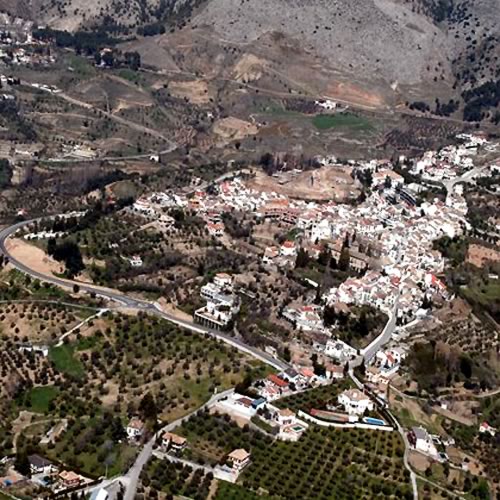
This town in the Sierra de Alfaguara, just outside Granada itself, is the highest in the area, at an altitude of 3,400 feet. Its cooler climate and proximity to the regional capital has made it a favorite location for summer residences of Granada's well-heeled. Viznar was also where the 18th-century Archbishop of Granada, Don Jose Manuel Mososco y Peralta, decided to build his summer palace in 1780. Archbishop Mososco was born in Arequipa in Peru, and named his impressive neoclassical mansion after his native land's capital city, of which he was also Archbishop. Palacio de Cuzco, built in 1795, has an Italianate garden, one wall of which carries depictions of scenes from Don Quixote, of which the Peruvian prelate was a keen scholar.
Granada - 6 miles