


Destinations
❮Main Menu
Experience Bistrita
Overview
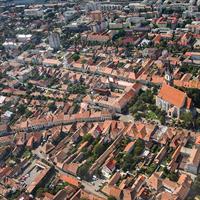
The northern Romanian city of Bistrita was founded in the early 12th century by the Saxons and became one of Transylvania’s major Medieval cities. Situated along the main trading route in Moldavia early remnants of the ancient city can still be seen in the historical old quarter’s cobblestone streets and the 13th century Minorite Monastery.
Bistrita was mentioned in Bram Stoker’s novel Dracula, the character Jonathan Harker stays in Bistrita at the Golden Krone Hotel, before heading to the Count’s lair in Borgo. The medieval city is decorated with pastel-colored Renaissance-style buildings and whitewashed churches and the charming streets are lined with cute cafes, a relaxing place to stay and absorb the laid-back atmosphere.
Named after the Bistrita River, whose name came from the Slavic word Bystrica, meaning “fast-moving water”. The city is nestled at the foot of the Bargau Mountains, one of the oldest towns in the region close to the Borgo Pass which connects Transylvania to the Bucovina region.
Things to see and do
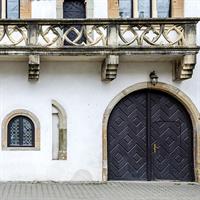
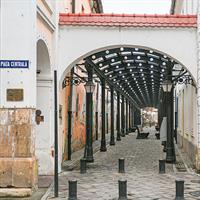
Bistrita has a historical old quarter in the heart of the city hemmed with colorful ancient buildings that house cafes, restaurants, and shops. The area is great for leisurely walks and to check out the shops and sit outside the restaurants to enjoy the warm summers. There are narrow passageways that are pedestrianized where visitors can find hidden gems such as cozy bars and restaurants.
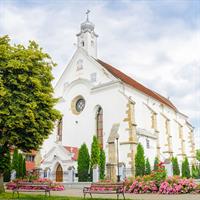
In the central square, the main attraction is the Lutheran church built by the Transylvania Saxons constructed in the 14th century featuring Gothic Renaissance-style architecture.
The Minorite Monastery is another major attraction situated close to the old defensive walls, it is one of the oldest buildings in the city. The monastery was built between 1270-1280 and has undergone many repairs, alterations, and renovations over the years. It served as a bar and wine cellar after the Minorite order left the town in 1541, and returned to a catholic church in 1724, and turned into an Orthodox church in 1948.
Turnul Dogarilor or Cooper’s Tower is one of the few remaining parts from the 18 medieval fortifications in Bistrita built to protect the city in the Middle Ages. The tower is open for visitation and now houses a dolls and masks museum that is well worth a visit.
Sugalete Row in Piata Centrala is a group of thirteen connected homes that were built in the 14-16th century built in typical Renaissance-style construction. They are lined up on one side of the old square, colorful buildings connected through their spacious entrances, forming a gallery of 20 arches.
Bistrita Nasaud County Museum features an interesting rich collection of Romanian, Hungarian, and Saxon folk art including ethnography, archeology, and geology collections.
The ostrich is featured on Bistrita’s coat of arms since the beginning of the 1300s, it is also the town’s seal. A crowned ostrich was the symbol of the d’Anjou dynasty and was gifted to the town for support in a conflict with the Hungarian nobility. In 2011 several colorful statues of ostriches started filling the old town streets, trying to find them all is a fun way to discover Bristita. +
Bistrita is a great starting point for a hiking trip to the spectacular Bargau Valley. This is one of the wildest and most impressive landscapes in all the Carpathians, and the area served as an inspiration for Bram Stoker’s famous Dracula. Indeed, the Bargau Castle, built to protect the pass with the same name, is often associated with the legendary vampire lord.
Travel to Tausoarea Cave, one of the deepest caves in Romania located in the deeply forested area in the Rodna Mountains in Bistrita. Also known as Tausoarelor Spring Cave, a large grotto with 12 ½ miles of galleries that extend over 1,354 feet in depth, at 3,116 feet altitude. Two and a half miles into the cave there is a 50-foot cascading waterfall.
Saxon village is a great location for visitors who are interested in the traditional way of life situated in a hilly area around Bistrita dotted with charming centuries-old villages. These villages preserve the distinctive traditional Saxon architecture in the houses featuring high walls around the yards, vibrantly painted glass, a frequent style that can be observed throughout the Transylvania region. The Saxon cities – The town can be included in a tour of the Saxon cities of Transylvania

History and Culture
Bistrita is one of the Seven citadels of Transylvania situated in the northern region of Romania, in the scenic vicinity of the Bargau Mountains and the nearby Bargau Pass, connecting Bucovina to Transylvania. There is archeological evidence in the area of inhibition that dates back to the Neolithic era. The first documents mentioning the city are from the 13th century, with the settlement being called Villa Bistiche.
The Turkic Pechenegs settled in the area in the 12th century following attacks of the Cumans and Transylvania Saxons settled in the area in 1206 calling it Nosnerland. A large portion of the city’s settlers were fugitives, convicts, and poor people looking for lands and opportunities. Bistrita was situated on several trade routes and became a flourishing medieval tradition post.
The city became a free royal town in 1330, and in 1353 King Louis I of Hungary granted the town the right to organize an annual 15 day fair on Saint Bartholomew day, as well as a seal containing the coat of arms of an ostrich with a horseshoe in its beak.
Bistrita was given the right to be surrounded by defensive walls in 1409, the city’s fortifications had 18 defensive towers and bastions built-in 1465 that defended the local guilds. Forest in the 19th century destroyed most of the city’s medieval citadel.