


Destinations
❮Main Menu
FOOD IN GREECE


Every table in the summer would include a communal plate of Greek salad. Your meal`s most likely include a plate too ("horiatiki salata" = village salad, is best). Since the country is a major exporter of fruits and vegetables chances are good that your salad would be made with fresh, and very tasty ingredients.
With so much sea shore surrounding the land and the islands, fresh fish of any kind (you can ask to see the fish before it is cooked) would be an excellent choice, albeit a pricey one.
Other visitors` favorites include Kalamari squid (fried or sautéed with onions and red wine) and the famous Gyros (gee`ros.) As you will find out not all gyros are created equal, ask the locals for the best restaurant, or look for the establishment that is full of locals.
While many non-Greeks frown at the idea of eating Octopus, those who do try it find its taste unique and very agreeable. It can be cooked grilled on charcoal with lemon, boiled, or prepared into a cold salad. Similarly, squid (Kalamari), and Cattlefish (Soupia) offer a unique taste and texture either served on their own, stuffed with cheese, or mixed with pasta. All three of the above can be eaten either as a meal, as an appetizer, or as `mezedes` (tapas) accompanying ouzo and white wine.
You can find individual Spinach Pies (spanakopita), and Cheese Pie (Tyropita) in fast-food joints around every town in Greece, and they are ideal for a quick breakfast or snack on-the-go. You can also eat them as appetizers with either lunch or dinner, but home-made pies have a richer taste and are hearty enough to have as a main course.
Greece is a fruit-producing country. In the summer you can indulge in fresh melons, peaches, apricots, and the ubiquitous watermelons. On the rural roads in Greece you will see little kiosks where the farmers sell produce and fresh fruits. Don`t miss out on the opportunity to buy some fresh fruit if you pass one.
Although one can find different ethnic foods in Athens, the great majority of restaurants in Greece serve only one variety of food: Greek food! To most people who consider variety to come from different types of cuisines this might sound rather monotonous, but Greek food comes in many shapes, forms, and varieties to keep even the most demanding traveler satisfied.
There are restaurants located in the busiest parts of town, such as the waterfront of most coastal towns and islands. They exhibit exceptional service, delicious food, and moderate to high prices. In fact, the closer you get to the waterfront, the higher the prices seem to climb. But there is no price too high to pay for a late dinner right next to the slithering reflections of the moon over the gentle waves.
A little farther wandering around the narrow streets of most cities will reveal the places that the locals frequent. Although there is no written rule that establishes such restaurants as better than others, a little exploration might reward the visitor with a restaurant that offers great Greek food at great prices, and in an authentic local atmosphere.
Every restaurant in Greece is obligated by law to exhibit the menu with prices by the entrance. This way you can stroll down a street, and browse at all the menus and prices before you make a decision to enter a certain restaurant. Often, there is a waiter by the door that will politely (and sometimes insistently) try to entice you to enter their restaurant.
While the menus exhibit all the current prices, you might notice next to certain items the notation "current market value" instead of a price. Items such as fresh seafood are almost impossible to determine a set price for the menu. Once inside the restaurant the waiter will make sure that you are informed of all the available fresh fish varieties , and will display the fish for you to make a choice. It is wise to make sure that you are at least verbally informed of the price of the fish you choose before it is cooked.
Most everything on a Greek taverna menu is straight forward. You may choose from a great variety of Greek delicacies like Pasticcio, Mousaka, or giuvetsi, or from a variety of pasta dishes. Greeks often ignore menu items when ordering and instead they custom order their own plates and most often order much more food than is possible to consume!

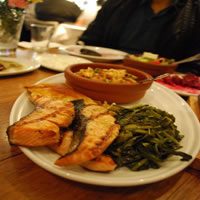
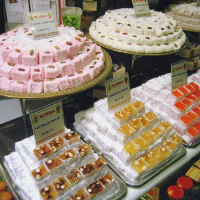
Restaurants are most often referred to as Tavernas. Fish Tavernas (Psarotaverna) if the main focus on the menu is seafood.
Greek dinner starts sometime around 10:00 PM and ends sometime after 1:00 or two AM!
The atmosphere of most tavernas (especially the ones the locals frequent) is most festive into the wee hours of the morning with loud conversations which relegate the Greek music to a background role, children running everywhere, cigarette smoke mixed with the aromas of tasty dishes, small cats under tables in search of scraps, and much beer and wine flowing happily from glass to mouth.
It is amazing to see that on most nights, every taverna in every Greek town is packed with people! Greeks don`t wait for the weekend to go out, and after a good meal they enjoy a few more hours of conversation and drinks at the table, or at a nearby cafeteria, or bar. It goes without saying that there is no closing hour established for restaurants, bars, cafeterias and night clubs. About ten years ago the government almost toppled when they tried to establish a 4:00 AM closing time for night clubs! No government has since attempted the same feat.
Some tavernas still offer a `free` gift of food or drink after a meal. You may get apple slices with nutmeg, baklavas or even an ouzo brandy. Too often this happens on your first visit only, although some continue the tradition.
Service is sluggish at best. Expect to wait to order, to wait for your meal and to wait for the bill. Note how irritating it can be to wait for service while watching the sun set on a balmy evening outdoors.
Greek wines have had a deservedly dire reputation for years. Things have improved recently thanks to subsidies to winemakers to modernize their plant and there are now half decent wines to be had. Even the cheap and cheerful Demestika, once nicknamed Domestos, is now not too bad.
Names to look for are Boutari and Rotonda for reds and Lac des Roches and Achaia Claus for whites. Many islands have their own distinctive labels. Crete, Santorini and the Ionian islands of Kefalonia and Lefkas are notable examples.
Retsina is Greece`s best known wine with a distinctive taste of pine resin inherited from pine plugs once used to seal wine jars. Pine needles are now added to flavor the fermenting wine. It is an acquired taste and is best drunk cold. Draught retsina is a big improvement on the bottled stuff and, strangely, tastes best of all from the can.
Ouzo is a lethal aniseed flavored drink best given a wide berth unless you are prepared to pay for the best. The best is distilled on Lesvos and is about 50% proof. Greek brandy such as Metaxa and Botrys are sweet and coarse. Metaxa with coke is a popular drink in cocktail bars.
Beer is mostly imported lager with Heineken and Amstel available everywhere. Greek beer is worth a try and if you spot Hellas or Mythos on the shelves then ask for it.
Expect to pay through the nose for soft drinks, especially fresh orange juice, although, it has to be said, the stuff is absolutely delicious.