


Destinations
❮Main Menu
Experience Lighthouse's of The Great Lakes
Overview
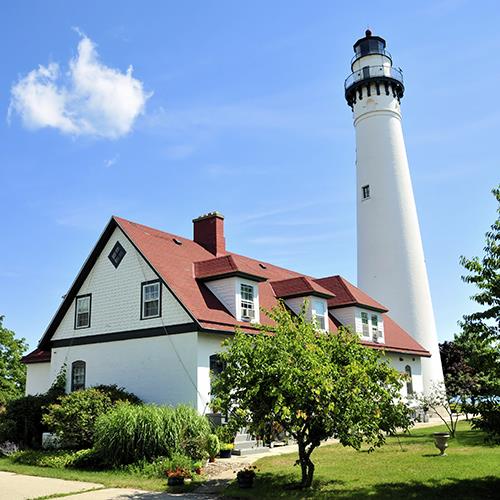
There are many charming nostalgic lighthouses to see in the Great Lakes region, they conjure up; memories of a different era and often call to mind the romance of the open water and ships making their way with the lonely lighthouse keepers maintaining a dutiful watch. Lighthouses are so cool and there are many still standing despite their obsolescence and some are open for the public to visit. These great lighthouses are tall and elegant, short and utilitarian, and beautifully restored there are dozens standing along Michigan’s 3,200 miles of shoreline that are well worth a visit. Many of the Michigan Lighthouses are open for tours, others are home to quaint beautiful bed and breakfasts, lodging, and museums, and others are privately owned or otherwise inaccessible. A lighthouse serves two main purposes to serve as a navigational aid to warn boats of a dangerous area, and as a point of reference to determine where you are on your journey and plot your course accordingly.

Things to see and do
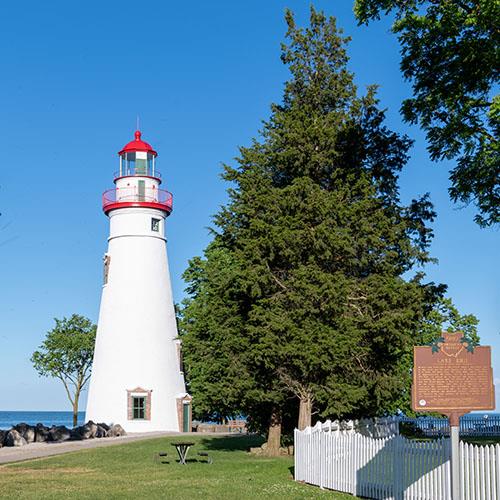
Lighthouses are some of the most unique buildings you can see, beyond their main function these tall towers with their bright lights at the top are instantly recognizable and make for great vistas and photo ops. The Great Lakes feature a veritable cornucopia of lighthouses to be seen and some that are open to the public to visit.
The Fresnel Lens is a giant piece of very intricate glass located at the top of every lighthouse. The purpose of the lens is to concentrate the light from a lamp at its center into a very focused, powerful beam that can be seen for miles across the water. Named after a French physicist, Augusti-Jean Fresnel, who invented it in the 19th century. The design was quickly adapted for use in lighthouses because of its relatively lightweight and cost. The lens uses concentric rings of ridged glass that help focus the light from the lamp at the center of the lends into a parallel beam that can be seen up to 20 miles away.
Lake Michigan is home to 102 Lighthouses, found in each state that borders the lake. Lake Erie is home to numerous lighthouses. Lake Huron is home to 98 lighthouses, many found around Lake Huron’s Thunder Bay Island. Lake Superior features 72 lighthouses, 42 of which are located in Michigan. Big Bay Point Lighthouse offers a unique opportunity for overnight stays in a historic lighthouse. Indiana’s oldest remaining lighthouse is located on the edge of Lake Michigan, it was the state's first lighthouse built back in the 1800s on the busy natural harbor. There are beautiful Michigan lighthouses scattered throughout the shoreline offering waypoints to those on the water and are landmarks of history for those on land. Lake Ontario features 53 lighthouses, most of which are located on the St. Lawrence river.
Lighthouses on Lake Superior
Eagle River Lighthouse
Eagle River Lighthouse sits at the western entrance to Eagle Harbor, guiding ships around the Keweenaw Waterway. It was built in 1851 as a guide for ships calling to Eagle River port, it was constructed to manage the shipment of ores during the UP’s copper mining boom of the mid-late 19th century. Today it is part of the Keweenaw County Historical Society’s Light Station Museum Complex, it is open to public visit. There are ample rooms to enjoy a historical stay at the lighthouse accommodations overnight with tons of living space and views of the surrounding area. Eagle Harbor is nestled on the shores of Lake Superior, it is an unusual lighthouse in Michigan to guide mariners as they navigate the rugged northern tip of the Keweenaw Peninsula. The current red building brick building, a Michigan State Historica Site listed on the National Register of Historic Places, it was built in 1871 to replace the old lighthouse. There is a tiny marine museum housed in the lighthouse keeper’s charming home, which is still operational and open to visitors. The light is still active and open for tours.

Sand Hills Lighthouse
Sand Hills Lighthouse is a privately owned property that now features a bed and breakfast, the lighthouse itself is closed to the public, and the grounds and tower can be toured if you stay at the Inn. The lighthouse was built in 1919 as a warning about the nearby reef, during WWII it was used as a training facility for the U.S. Coast Guard. It was an active lighthouse on the shores of Lake Superior, located in Ahmeek in Keweenaw County in the Keweenaw Peninsula, in the northern portion of the UP. It was listed in the National Register of Historic Places in 1994. The lighthouse is a grand structure built of buff-colored brick consisting of a 70-foot tower that is surrounded by three separate apartments for three keepers. Each apartment had its own access to the second floor of the tower, the apartments feature hardwood floors, and their own cellars surrounding a central basement that housed the station’s hot central heating and water supply systems. Construction began in 1917 and the light went into operation in 1919 and then went out of service in 1945.

Big Bay Point Lighthouse
Big Bay Point Lighthouse is located on a bluff northwest of Marquette on the shores of Lake Superior, the red brick lighthouse stands 60 feet tall with a square tower that dates from 1896, it is topped with a stunning white lantern that shines the brightest light on Lake Superior. The lighthouse has been converted into an Inn with 7 guestrooms named for former lighthouse keepers, the rooms are furnished with period furniture, and guests can wake up to spectacular morning views of the lake. Big Bay Point Lighthouse’s lantern is visible for 20 nautical miles, and the lighthouse continues to aid Coast Guard navigation in the UP. There are tours of teh 60-foot tower available from June through September. Big Bay Point lies directly between the Huron Islands and Granite Islands stretching for 18 miles through the rough waters where many ships have sunk. The tower itself is part of a structure that includes two stories, a duplex, eighteen rooms, and a lantern room. In 1941 the lighthouse keeper left the premises and the tower was registered as officially unwatched. The property was a private residence from 1961-1979 and was owned by a plastic surgeon from Chicago named Jon Pick. He renovated the building for two decades and turned the duplex into a bigger room then sold it in 1980.

Au Sable Light Station
The Au Sable Light Station is located within Pictured Rocks National Lakeshore, West of Grand Marais, and stands 86 feet tall, it extends underground for 23 feet, which anchors it to the bedrock. The lighthouse was erected in 1874 to alert mariners to a potentially treacherous reef off Au Sable Point, it is accessible through a 1.5-mile gravel trail that features a lovely walk along the edge of Lake Superior’s shoreline. The light station includes the lighthouse as well as a brick oil building, a fog signal building, and the keeper's house. The lighthouse is listed on the national register of historical sites, and the light station is now automated and returned to its 1910 appearance. There is a small museum within the keeper's house, and a smaller 1909 building recreates the keeper’s living quarters from the early 20th century. Au Sable Point Lighthouse is one of Lake Michigan’s earliest constructed lighthouses, along with the Whitefish Point Lighthouse. The lighthouse is currently solar-powered, and the removed third-order Fresnel lens is still on the premises. Visitors can access this remote lighthouse by following a one-and-a-half-mile trail along the edge of Lake Superior.
The Rock Harbor Lighthouse
The Rock Harbor Lighthouse is a light station located in Rock Harbor on Isle Royale National Park in Michigan. The white lighthouse stands 50 feet tall with a cylindrical tower with a 16-foot diameter base, constructed of randomly placed stones and bricks and capped with an octagonal beacon and a copper roof. The lighthouse was placed on the National Register of Historic Places in 1977, it was completed in 1855 at the southwest entrance to Rock Harbor, one of the most historic and most visited lighthouses. The keeper’s house is an attached one-and-a-half-story house with a gabled roof that is connected to the tower, which is now a museum. Rock Harbor is no longer illuminated as it was permanently closed in 1879. The lighthouse can only be accessed via a ferry, private boat, or seaplane. Isle Royale National park offers maritime exhibits on a guided NPS tour that includes a stop at the lighthouse and the nearby Edisen Fishery.

The Copper Harbor Lighthouse
The Copper Harbor Lighthouse is located in the heart of Copper harbor in the Upper Peninsula of Michigan, it is the gateway to Keweenaw Peninsula’s best outdoor recreation and departure point for ferries to Isle Royale. The lighthouse was constructed in 1861 and consists of honey-colored dressed stone and brick, a square tower with an attached keeper’s house. Enjoy views of Copper Harbor and its light from the water on a boat tour that departs from the light. The lighthouse was built with the intention of aiding the transportation of copper ore mined in the UP. Today the Copper Harbor Lighthouse is closed to the public in favor of the range lights installed in the harbor in 1865.
Whitefish Point Light Station
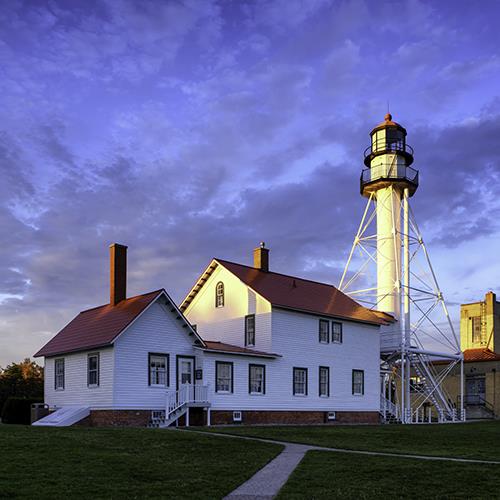
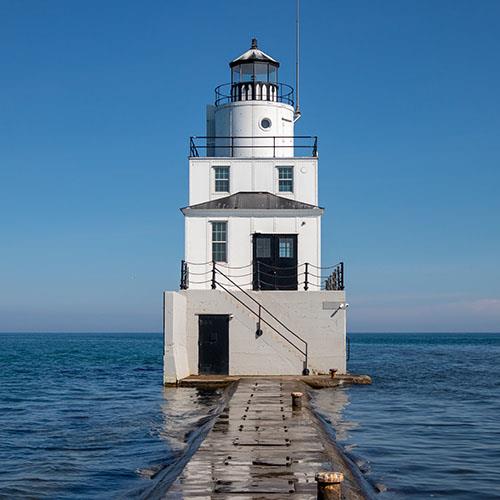
Whitefish Point Light Station is located in Paradise, Michigan on the southern shores of Lake Superior, it is the oldest continually operational lighthouse on the lake. The lighthouse is positioned at a critical turning point for vessels, there are over 500 shipwrecks in the area, and today the lighthouse is home to the Great Lakes Shipwreck Museum, where visitors can learn more about the SS Edmund Fitzgerald ship and more. It was built in 1841 and is the oldest working lighthouse its location is known as the “Graveyard of the Great Lakes”. The museum displays artwork, shipwreck models, antiquities, and lifelike mannequins. Whitefish Point is an 80-foot-tall lighthouse, with the old crew’s headquarters on site that has been converted into a hotel. “Shipwreck Coast” is an infamous 80-mile span of coastline where vessels have sunk between the Point and Munsing, Michigan. The lighthouse featured an outdated Winslow and Lewis reflector/lamp system that was replaced in 1857 with a Third Order Fresnel Lens. The lighthouse had to be rebuilt after years of battering from the intense weather conditions of Lake Superior had decimated the structural support of the building, so it was reconstructed with steel to ensure proper support even under harsh weather conditions.
The Grand Island East Channel Lighthouse
The Grand Island East Channel Lighthouse is one of Michigan’s most distinctive lighthouses, a wooden structure constructed in 1868, and features a square light tower. The lighthouse stands to the north of Munising, Michigan, and was built to direct vessels from Lake Superior into the harbor in Munising by guiding them through the canal east of Grand Island. The light sits surrounded by the wilderness of the Pictured Rocks National Lakeshore, the light is privately owned and not accessible to visitors (other than private tours), and the tower replicates an old church as it is positioned on Grand Island’s shores of Lake Superior. Munsing Harbor is known as the harbor of refuge for ships on the lake, situated on the southern end of Grand Island, it can be viewed in a variety of ways including from Sand Point within Pictured Rocks National Lakeshore, aswell as on the water by either boat tours or a private vessel. The lighthouse is unique and majestic, in wintertime its located right next to the world-famous Grand Island Ice Caves and in the summertime, it is the perfect place for kayaking and hiking. The light atop the tower could project a full 49 feet across Lake Michigan and was fully operational by August 15th of 1866. In 1869 a fifth-order Fresnel lens was installed to upgrade the steamers lens that had been used up until then.
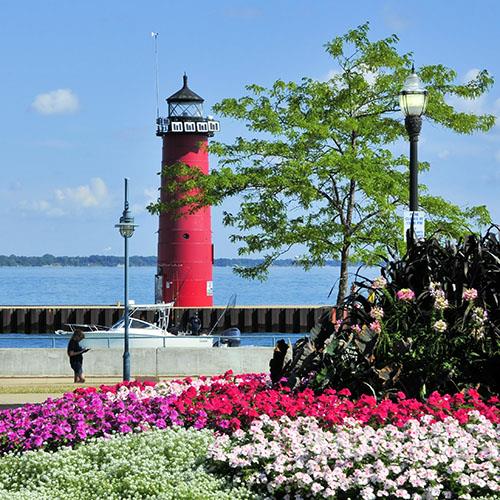
Point Iroquois Lighthouse
Point Iroquois Lighthouse is situated at the entrance to St. Marys River in the charming small town of Brimley, Michigan, on the banks of Lake Superior. The lighthouse stands 65 feet tall and was built in 1855 at the boundary between Whitefish Bay and the westernmost portion of St. Marys River, it was decommissioned in favor of a more m modern beacon in 1962. This is one of the busiest shipping channels in the world was formerly illuminated by its light. Now a popular tourist attraction and open for tours from May through October, the grounds are always open to the public. Point Iroquois Lighthouse is one of the tallest in the state and visitors can climb the tower and enjoy phenomenal views of Lake Superior, the St Mary’s River, and more. St Mary’s River is home to the Soo Locks and connects Lake Superior and the rest of the Great Lakes. The lighthouse's Fresnel lens allowed its beam to project sixty-five feet across the waters. The booming iron ore and copper trade compelled Michigan to create the St. Mary’s Falls Canal to help ships transport these necessary goods across the southern Great Lakes. The canal began operating in 1865 and since then has become the most used canal by commercial shipping vessels in the world. The Lighthouse was replaced by an automated light in Grs Cap, Ontario, and was entered into the National Register of Historic Places in 1975.

Eagle River Lighthouse
Eagle River Lighthouse sits at the western entrance to Eagle Harbor, guiding ships around the Keweenaw Waterway. It was built in 1851 as a guide for ships calling to Eagle River port, it was constructed to manage the shipment of ores during the UP’s copper mining boom of the mid-late 19th century. Today it is part of the Keweenaw County Historical Society’s Light Station Museum Complex, it is open to public visit. There are ample rooms to enjoy a historical stay at the lighthouse accommodations overnight with tons of living space and views of the surrounding area. Eagle Harbor is nestled on the shores of Lake Superior, it is an unusual lighthouse in Michigan to guide mariners as they navigate the rugged northern tip of the Keweenaw Peninsula. The current red building brick building, a Michigan State Historica Site listed on the National Register of Historic Places, it was built in 1871 to replace the old lighthouse. There is a tiny marine museum housed in the lighthouse keeper’s charming home, which is still operational and open to visitors. The light is still active and open for tours.
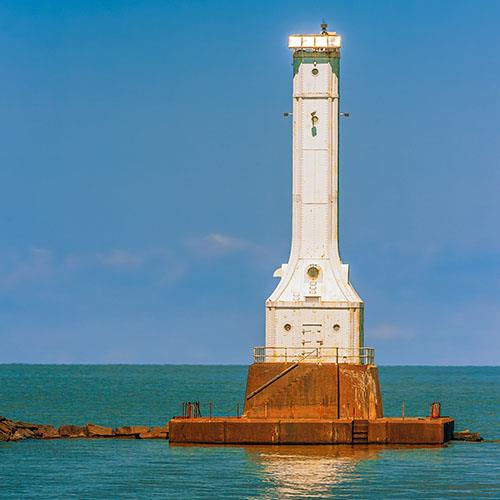
Lighthouses on Lake Michigan
The Beaver Island Harbor Lighthouse
The Beaver Island Harbor Lighthouse is located in St. James, Beaver Island, 27 miles off the coast of Charlevoix in Michigan. This is the largest island in Lake Michigan named for the many beavers once inhabiting it, the lighthouse was built in 1851 and travelers can visit the lighthouse and watch the Beaver Island Boat Co come and go, relax amid the piece of history on this tranquil island. The quaint Beaver Island Toy Museum is located just down the street from the lighthouse with a small shop filled with antiques, beads, toys, jewelry, and an art gallery. The lighthouse sits on the southern end of the island on a quiet stretch of land overlooking Lake Michigan, a honey-colored brick building that visitors can climb to the top of the tower and admire the views. There are 14 islands that make up the Beaver Island Archipelago. The lighthouse sat atop Whiskey Point at the entrance to Paradise Bay, the body of water created by the natural harbor. The brick tower rose up 41 feet and features a fourth-order Fresnel lens, it currently serves as an active navigational aid with an automated light. The new tower features the automated light in a white cylindrical tower capped with a black cast iron parapet.
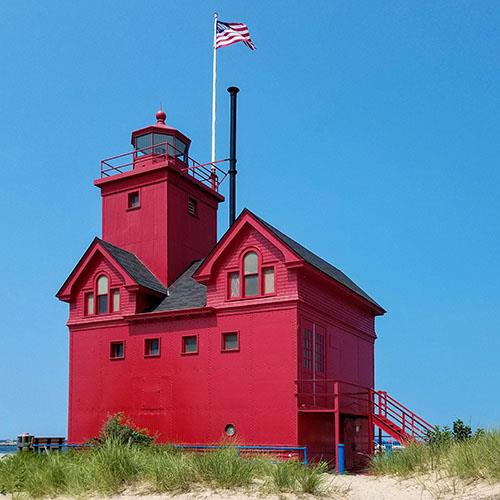
The Big Red Lighthouse
The Big Red Lighthouse, formally known as the Holland Harbor Light, is the most popular in photographs in Michigan. This brilliant red structure with a light tower and a black roof can be seen along the Holland Channel. Built in 1907 and is one of the state’s most magnificent and distinctively constructed lighthouses, the construction pays homage to the classic Dutch architecture of the town’s earliest immigrants. The lighthouse is currently owned and maintained by a non-profit lighthouse commission, it is best viewed from the beach at Holland State Park where it sits just across the channel. It can also be viewed from Mt. Pisgah, where the dune staircase takes you 157 feet above sea level. The Holland Harbor Lighthouse is an integral part of the history of Holland, Michigan, Dutch settlers came to the area in 1857 and wrote to the governor and Congress requesting funds for the building of a harbor. A permanent pier was built into Lake Michigan which was battered over the years by harsh winter storms, dredging was done by hand and machine. Citizens managed to cut a new channel-present location from Lake Macatawa to Lake Michigan in 1860 and it was deep enough for barges to float between the two. The first lighthouse was built in 1870, it was a small, square, wooden structure that stood on an open platform on legs above the deck of the pier. On top was a lantern deck with a ten-window lantern room.
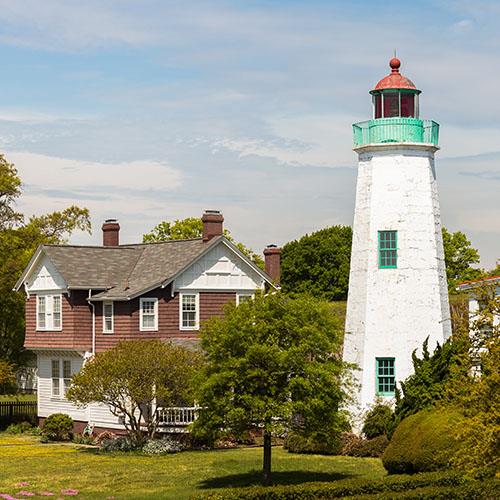
St. Helena Island Light Station
St. Helena Island Light Station is located on the tiny island of St. Helena just west of St. Ignace in West Michigan. The lighthouse was activated in 1873 and is a frequent landmark on Shepler’s Ferry’s lighthouse tours featuring a 71-foot tall tower. This brilliant white tower topped with an eye-catching red lantern was built to guide vessels through the Straits of Mackinac, passing a dangerous shoal that extends from the island. The lighthouse was automated in 1923, and in 1986 the Great Lakes Lighthouse Keepers Association along with the local Boy Scout troops started preservation. Many small vessels took refuge in the natural harbor on the north side of St. Helena Island. The island lies two miles offshore from Michigan’s Upper Peninsula, and ten miles west of the world-famous Mackinac Island. The uninhabited island once had a thriving community of over 200 people, it now only sees around 250 visitors during the summer to see the lighthouse, located on its eastern end. St. Helena Island features a fine natural harbor on the northern shore which offers shelter from fierce southwesterly storms that sweep the entire length of Lake Michigan, often producing mountainous waves. Waugoshance Lighthouse was the original lighthouse on the island built in 1847, it was the site where wooden piers were constructed before being towed out to the shoal and filled with stone. In 1872 Congress approved funding for a new light station on St Helena, and the tower and keepers’ quarters were completed the following year. The station’s 3 ½ order Fresnel lens was lit for the first time in September 1873. In the 1890’s they added additional structures, including an oil house, wharf, and boat house, were added in the 1890s.

McGulpin Point
McGulpin Point is situated on 10 acres, two miles west of Mackinaw City, it is one of a dozen or more lighthouses established to keep the Straights of Mackinac safe for shipping traffic. The lighthouse was constructed in 1869, a yellow brick building with a fully restored light that is available to tour and explore with sweeping views of the Straits and the famous Mackinac Bridge. The discovery trail at McGulpin Point Lighthouse talks about the lighthouse's historical grounds, there are also apartments next to the lighthouse where guests can stay overnight. Today it is a historical site and public park, the lighthouse is one of the oldest standing in the Straits and began operating in 1869, the light was used until 1906. The Lighthouse Board decided to build Eagle Harbor Light in 1871 using McGulpin’s design, a Norman Gothic-style lighthouse leading mariners through the Straits. The Point is a popular destination attracting thousands of visitors a year, explore the Village of Mackinaw City and Heritage village, and the lighthouse’s discovery trail which tells the story of the building, as well as the overnight lodging opportunities on site. McGulpin Point Cottage is situated on the lighthouse grounds offering secluded apartments, next to the lighthouse and minutes from downtown Mackinaw City with easy access to restaurants, shops, beaches, and the acclaimed Headlands International Dark Sky Park.
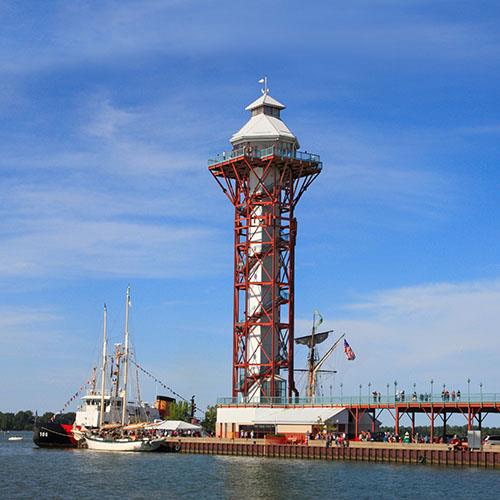
Great Traverse Lighthouse
The Great Traverse Lighthouse sits at the end of the Leelanau Peninsula near Traverse City, it was constructed in 1858, as a vividly white and red building with views of Lake Michigan, Cathead Bay, Grand Traverse Bay, and the Manitou Passage. The lighthouse is open to the public for tours and visitors can climb the tower and explore the keeper’s quarters that have been restored to their 1920s appearance. There is a playground at the adjacent Leelanau State Park and treasure hunts available for kids. The Leelanau Peninsula separates Lake Michigan and Grand Traverse Bay, it marks the Manitou passage, where Lake Michigan elides into Grand Traverse Bay. The Fog Singal building is available to visit and tour the Shipwreck Exhibition, where you can also drive the Remote Operated Vehicle (ROV). The Lighthouse Museum is also open during the summer but closed in winter, the state park remains open to the public after purchasing a Recreation Pass during daylight hours. Grand Travers is a historic, major port on Grand Traverse Bay near the once bustling Manitou Passage, there are many opportunities to explore historic lighthouses in the region. Including Mission Point, Grand Traverse, South Manitou, North Manitou, Fox Island, Robert Manning Memorial, Point Betsie, and Frankfort North Breakwater.
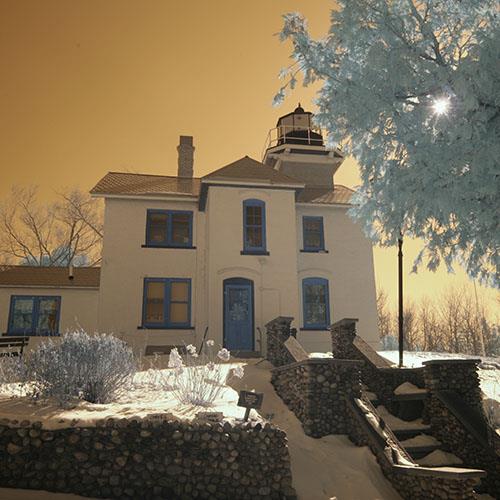
Mission Point Lighthouse
Mission Point Lighthouse is situated at the tip of the Old Mission Peninsula in Lighthouse Park, it was built in 1870 to warn ships away from the dangerous shoals that extend into Grand Traverse Bay. The picturesque lighthouse is the centerpiece of an attractive park featuring popular beaches, historical exhibits, picnic facilities, extensive all-season hiking trails, and more. There is a Mission Point Lighthouse museum to visit as well as a quaint gift shop that is open to the public most days from May through October, and November on Saturdays and Sundays. Hessler Log Cabin is a restored turn-of-the-century log cabin on the lighthouse grounds that is open for viewing. Mission Point is on a peninsula that juts into Grand Travers Bay, 17 miles north of Traverse City. It was an exact copy of the Mama Juda Light, which was built on the Detroit River in 1866. There is a picturesque drive along M-37 through cherry orchards, and vineyards, the lighthouse stands as a classic piece of Michigan history. The lighthouse was decommissioned in 1933, it now offers visitors a peek into what life was like around the turn of the century for lighthouse keepers and others who lived and worked in the area at the time.
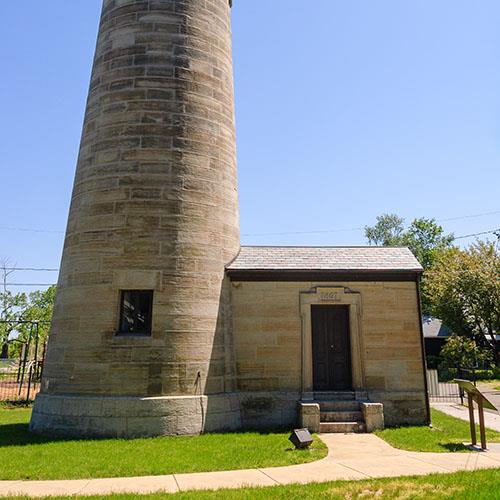
South Manitou Island Lighthouse
The South Manitou Island Lighthouse is located on South Manitou Island on Lake Michigan around 16 miles west of Leland, Michigan. South Manitou Island Lighthouse is one of the most familiar landmarks on this island and clearly visible from the mainland, it was built in 1839 and features a 100-foot tower. The lighthouse was active until 1958 when it was decommissioned and marked the location of the only natural harbor between Michigan and Chicago, where ships took refuge against dangerous storms, and steamers stopped at the island to refuel with wood for their boilers. South Manitou Island is located six miles off the coast of the Sleeping Bear Dunes National Lakeshore, you can only reach the island via ferry. Visitors can climb the 117-step spiral staircase to the lights black, wrought iron observation deck to enjoy wonderful views of the Manitou Passage, the island, and the mainland. There is a small campground on the island, the waters are great for snorkeling and underwater exploring with a beached shipwreck just off the coast. The lighthouse was completely rebuilt in 1872 due to deterioration, it is listed in the National Register of Historic Places. It is now a museum and open to the public.

Point Betsie Lighthouse
Point Betsie Lighthouse is located on the beautiful Lake Michigan shoreline south of the Sleeping Bear Dunes and north of Frankfort, Michigan. The original lighthouse was built in 1858 to safely guard mariners on Lake Michigan, the building, tower, keeper’s residence, fog signal, and Boathouse Museum are open to the public. At the lighthouse, visitors can explore and learn about the daily life of a lighthouse keeper, see the daily routines, and feel the danger of a long-ago Lake Michigan rescue. There is a gift shop on site to purchase unique gifts. There is an adjacent beach that can easily be accessed. Point Betsie sits on the northeast shore of Lake Michigan, at the southern entrance to the Manitou Passage. There are self-guided and semi-guided tours available. The lighthouse is 39 feet tall cylindrical structure perched on a dune, Pointe Betsie is considered one of Michigan’s most notable historic lighthouses. It is the oldest standing structure in Benzie County and sits at a once vital maritime shipping channel. This was once a spot that threatened ships en route to the Straits of Mackinac, a bright white tower and keepers house topped by a red roof and black lantern. Explore historic Frankfort a picturesque town with maple-lined streets, shops, restaurants, and galleries decorated with Victorian homes.

Big Sable Point Lighthouse
The Big Sable Point Lighthouse is situated on the eastern shore of Lake Michigan near Ludington in Mason County Michigan, at the Ludington State Park. Construction began in early 1867 on approximately 933 acres of land deeded by the State of Michigan to the U.S. at no cost, it was the first lighthouse in the area. The lighthouse stands 112 feet tall and was originally made of yellow cream brick, it has a focal plane of 106 feet, and the building was made of so-called Cream City Brick. The brick deteriorated over the years and was covered with boilerplate in 1900. Visitors can tour the lighthouse from early May to late October, there are also overnight stays available in the keeper’s quarters. The lighthouse is now black and white striped and sits on a lovely stretch of gold Lake Michigan beach where the perfect sunsets can be seen in a peaceful setting. The light remained active until 2002. There is less than a 2-mile walk along a hiking path to reach the immaculate setting.
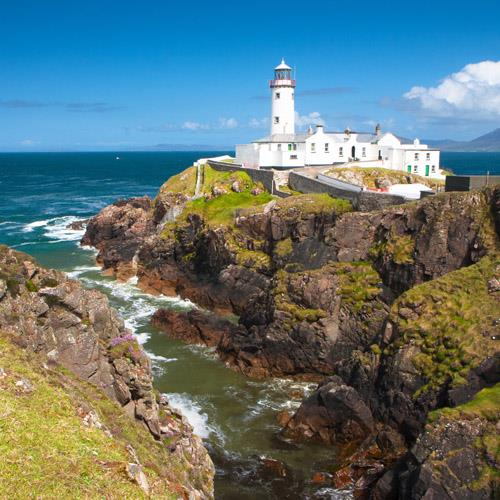
Muskegon South Pierhead Light
There are two lighthouses in Muskegon, Michigan; the Muskegon South Pierhead Light and the Muskegon South Breakwater Light. The brilliant red tower of Musekgon’s South Pierhead Light draws shutterbugs to this magnificent strand of beach, located near the Muskegon State Park, it was first lit in 1903 to guide ships from Lake Michigan up to the Muskegon River. Visitors may explore the grounds and take tours during the spring Opening weekend, you can walk year-round to both lights. The sister light; Muskegon South Breakwater Light (also known as Muskegon Breakwater Light) is located at the end of the south arm of the Muskegon breakwater surrounding the mouth of the Muskegon channel in Muskegon, Michigan. The site is accessible by walking the breakwater, and the light is available to tour. It is located at the Pere Marquette Park, at the end of a walkable 1,514-foot pier, it was built in 1931 as a red, ironclad, pyramidal tower that sits upon a rectangular base.

Grand Haven South Pierhead Inner Light
Grand Haven South Pierhead Inner Light is the inner light of two lighthouses on the south pier of Grand Haven, Michigan, where the Grand River enters Lake Michigan. The two lights were established in 1839 on the south pier, both are painted red and connected by a lighted catwalk connecting them to the shore and the Grand Haven Boardwalk. Grand Haven South Pierhead Inner Light is the inner light of two lighthouses, a lighthouse was first lit there in 1839, the inner light is cylindrical, and the fog house outer light stands on a huge concrete foundation. Visitors can stroll along the boardwalk which borders the Grand River and down the pier which is a popular spot for fishing and watching spectacular sunsets. The Inner Lighthouse was built in 1905 in the typical style of many of the lighthouses in Michigan, a round tower looks elegant in its vivid red with lights stringing out on either side. Follow the lights toward the lake where the breakwater’s second lighthouse stands, the other light was built in 1875 and boasts its own charm, resembling a small barn in appearance. In 2009 the U.S. Coast Guard determined it would no longer maintain the lights, they are now owned by the city of Grand Haven, and maintained by the Grand Haven Lighthouse Conservancy, a group dedicated to “keeping the lights on”.
Lighthouses on Lake Huron
DeTour Reef Light
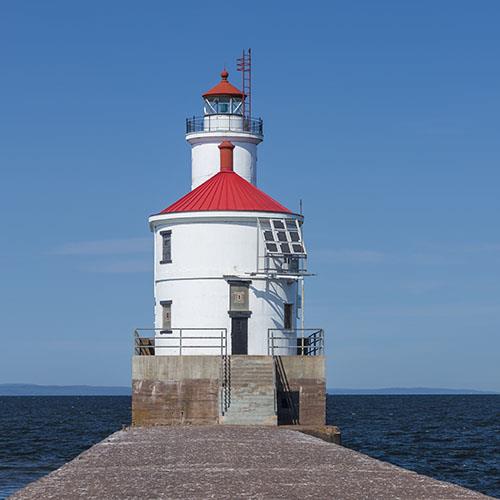
The DeTour Reef Light is a non-profit-operated lighthouse that marks the southern entrance of the DeTour Passage between the eastern end of Michigan’s Upper Peninsula and Drummond Island. The lighthouse was built in 1931 and stands 83 feet tall at a strategic and historic landmark that marks a dangerous reef to help guide ship traffic from and to Lake Huron and Lake Superior via the strategic St. Marys River. The light is an automated active aid to navigation, the passage is used by almost all of the Great Lakes commercial freighter traffic with approximately 5,000 vessel movements annually. It is said to be “the gateway to Lake Superior”. In 2004 major restoration took place, a keeper program lets you stay overnight at the light, and public tours of the unique light began in 2005 and are available on Saturdays between Father’s Day and Labor Day weekends. The classic revival style architecture of the white lighthouse is very eye-catching and made of reinforced concrete and steel, it sits atop a massive concrete pier. In 1974 the light was automated, and by 1997 the lighthouse was declared excess property by the U.S. Coast Guard. The lighthouse now offers a bedroom with a double bed and 2 bunks, and a kitchen, keepers take care of cleaning and maintaining the lighthouse, help with the guided tours, keep a log, and prepare their own meals.
Old Mackinac Point Light
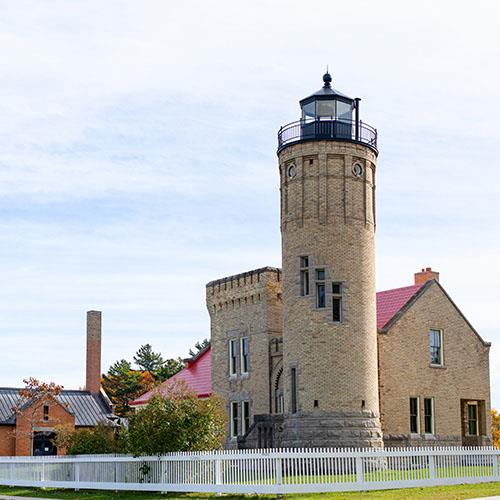
Old Mackinac Point Light is located within the boundaries of Michilimackinac State Park on the shorelines of Lake Michigan. Situated at the northern tip of the Lower Peninsula in the U.S. state of Michigan, in the village of Mackinaw City just east of the iconic Mackinac Bridge. The lighthouse was established in 1889 as a guiding beacon to help passing ships navigate through the treacherous waters of the Straits of Mackinac. Old Mackinac Point Lighthouse features authentically restore quarters and exhibits, including the original lens, a chance to explore the second floor of the house, tours of teh lighthouse tower, a movie, Shipwrecks of the Straits, and the Straits of Mackinac Shipwreck Museum. The lighthouse keepers’ Quarters contain three rooms that have also been restored and feature a gallery exhibit on the history of the lighthouse with hands-on displays and original artifacts. On the second floor, there is a gallery space and two bedrooms that tell the story of the Keeper George Marshall, his wife Maggie, and their extended family as they lived and worked at the lighthouse. Shipwrecks of the Straits and Old Mackinac Point Lighthouse Tower Tour are presented in the barn, the reconstructed warehouse features exhibits with audiovisual displays and a variety of original artifacts to tell the story of the numerous shipwrecks that dot the Straits. There is a demonstration of the Fog Signal Whistle led by a costumed interpreter that takes place in front of the Fog Signal Building at 10 am, 12pm, 2pm, and 4pm.

Cheboygan River Front Range Lighthouse
The Cheboygan River Front Range Lighthouse was established in 1880 in order to guide mariners from Lake Huron into the harbors, to the Cheboygan River. The Cheboygan River stretches for 7 miles from the north end of Mullet Lake to the Straits of Mackinac, it forms the boundary between Benton Township and Inverness Township before flowing into the city of Cheboygan. The wooden lighthouse which resembles a schoolhouse with a tall bell tower is painted red and white and has been fully restored, the tower and gift shop are open to the public. The keeper program allows volunteers to stay at the light station and open it for tours Thursday through Sunday between Memorial Day and Labor Day, after that tours are available on weekends through October.
Forty Mile Point Lighthouse
The Forty Mile Point Lighthouse is located in Lighthouse Park in Presque Isle County near Hammond Bay on the western shores of Lake Huron, Michigan. The square white lighthouse was completed in 1896 and has guided mariners through northwest Lake Huron. The lighthouse features a spiral staircase that leads up the 62-foot tower and features a lighthouse museum and pilothouse that are open to the public between Memorial Day weekend and mid-October. There is a shipwreck 200 yards from the lighthouse that dates from 1905, called the Joseph S. Fay, where 150’ of her side wall is resting on teh beach. The tower 4th Order Fresnel lens has been a welcoming beacon to sailors since 1897 and is still operating today. The light is named because it is on a 40-mile point which is 40 miles sailing distance from Old Mackinaw Point, just north of Rogers City. The lighthouse Society began restoration on the lighthouse in 1996 including the lighthouse, outbuildings, and grounds. There are over 27 wooden ships that sank during a fierce storm in 1905, on the “Shipwreck Trail”. There is a picnic area, swimming beach, and hiking trails as well as the steamer Calcite pilot house. There are 50 miles between the Cheboygan and Presque Isle lighthouses, and a station was needed midway between the two, so Forty Mile Point was created.
Presque Isle
Presque Isle is home to three historic lighthouses situated along the northeastern shore of Lake Huron, they symbolize the area’s rich maritime history. The Old and New Presque Isle Lighthouses are open for tours, and the new light station stands 113 feet tall, making it one of the tallest that can be climbed in Michigan. As ships past Michigan’s thumb, and navigated the St. Clair River and Lake Huron, they passed this point, the Pointe Aux Barques or Point of Boats. A tricky point to navigate, so to aid boats and Maritimers the soaring white Pointe Aux Barques Lighthouse became operational in 1848. The Presque Isle Light Station includes three historic buildings; the light tower that connects to the keepers’ quarters, and the unattached keepers’ residence was constructed in 1905, it has been fully restored and now serves as a museum. The buildings sit on a 99-acre township park that features a playground, picnic area, pavilion, and nature trails. There is a gift shop located in the original keepers’ quarters. Presque Isle is French for the peninsula, literally meaning “almost an island” on Lake Huron’s beautiful Sunrise Shore. houses and a station were needed midway between the two, so Forty Mile Point was created.
Sturgeon Point Light Station
The Sturgeon Point Light Station is a lighthouse situated on the shores of Lake Huron in Haynes Township in northeastern lower Michigan. The lighthouse was established in the spring of 1870 to ward mariners off a reef that extends 1.5 miles lakeward from Sturgeon Point. Today it is still an operational lighthouse and is regarded as a historical example of a Cape Cod-style Great Lakes Lighthouse. The lighthouse stands 79 feet tall with a 16-foot diameter at its base. The lighthouse and keeper’s house are masonry construction on a limestone block foundation. The light is a 3.5 Fresnel lens made in Paris, France, the light apparatus is still maintained by the U.S. Coast Guard. The keeper’s quarters are now a maritime museum open to the public 7 days a week from Memorial Day to Labor day Weekend. The tower is white and red and cannot be missed on the Lake Huron shoreline just north of Harrisville.