


Destinations
❮Main Menu
MASSIF CENTRAL - TOWNS AND VILLAGES

Clermont Ferrand
Clermont-Ferrand (commonly called Clermont), in the Auvergne Rhone Alpes region, is the capital of the Puy-de-Dôme department and the historical capital of the Auvergne. To the west, Clermont-Ferrand is overlooked by a granitic plateau on which lies the Puys chain and the Limagne fault, the largest chain of volcanoes in Europe, among which stands the most famous, the Puy de Dôme at 4,806 ft.
Created in 1731 by a merger of two towns, Clermont-Ferrand has a long history. However, today it looks as if it was created in the stark 1960s and 1970s. It’s not a town to spend too much time, but it’s an important rail hub in this region and has a number of attractions that do bring in visitors. As the Auvergne’s largest city, Clermont-Ferrand is a hub not only for business but cuisine, with plenty of restaurants serving modernized cuisine auvergnate, Beyond the myriad of lanes in the old town, the Auvergne’s capital is an industrial powerhouse, home to the Michelin automotive empire.

Limoges
Often underrated and overlooked in favor of its more famous neighbors, Limoges is the perfect place to experience France off the beaten path. Once the Limousin region of France, Limoges is best known for its porcelain production and Limousin cattle, which can be spotted in the rolling green hills surrounding the city. Visitors come here to explore the medieval history of Limoges and the stunning historic heart of the city.
The charming city of Limoges is most famous for its porcelain, which is known simply as ‘Limoges Porcelain’. A hard-paste porcelain, the wares continue to be produced to this day in factories surrounding Limoges. With a Grand Gothic cathedral, plenty of winding cobbled lanes, and a train station that’s often said to be one of the most beautiful in all of France, Limoges is a great city to explore, especially because it remains largely undiscovered by many tourists.

Vichy
Vichy, a spa town three hours south of Paris, sits like a grand old dame on the banks of the river Allier. There is nothing hurried or pretentious about the town, despite its lavish architecture, everything seems to move at a more leisurely pace once one crosses the river. The town became famous as a thermal spa resort in the 1800s, this is also when the town’s architecture was modernized but the splendor of Vichy remains its Art Deco architecture (1925-1935), tall buildings and balconies with ornate railing that line the quiet side streets. Visitors come here to enjoy the history, spas, stunning architecture, parks and manmade lake of the River Allier.
Aurillac
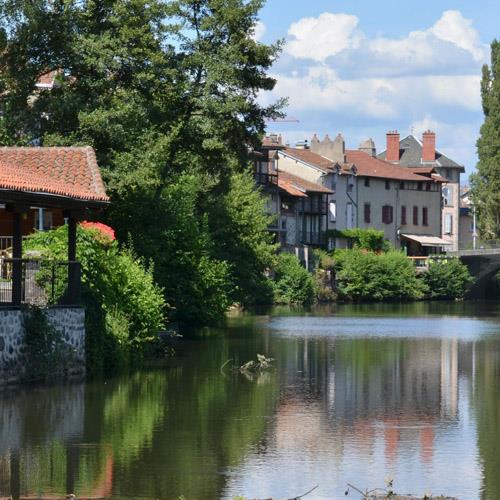
While Aurillac doesn't have any specific highlights or historic monument, it is home to several churches and buildings of interest, such as Aurinques Chapel, the abbey-church of Saint-Géraud and Notre-Dame-aux-Neiges (Our Lady of the Snow), and its museums (notably the Volcano Museum and the Museum of Art and Archaeology). Explore the charming old town, with narrow streets and a few shady squares, and plenty of nice shops and cafes to enjoy. The buildings are tall, imposing and in a local gray stone, which can be rather somber when the sun isn’t shining.
Visitors also come here to enjoy sports and leisure. Swimming, fishing and water activities can all be done outside of the town. For swimming, there is the Centre Aquatique du Bassin d'Aurillac (Aurillac aquatics centre) and St-Etienne Cantales Lake. Also visit the Etangs de Marfon (ponds of Marfon), where a heated pool, pony rides, children's games, pedalos, minibikes and trout fishing are all available. Sailing, canoeing, canyoning, wakeboarding, water-skiing, horse riding, golf, paintball, rock climbing,pétanque, hot air balloons and many other activities can be done in Aurillac!
Puy en Velay
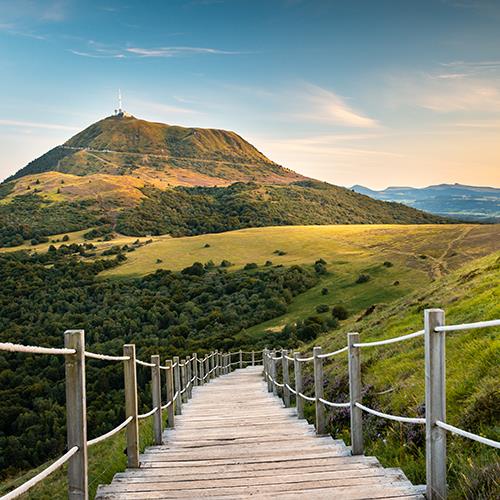
Le Puy-Velay (commonly referred to as Le Puy) is a small town with one of the most extraordinary sights in France. Steep volcanic peaks, left over from geological activity that ended millennia ago, are capped with Romanesque churches, a cathedral, and medieval houses that rise sinuously from the plain below. The town has been an important religious center for centuries as it’s where one of the Camino routes in France starts. The UNESCO-protected route leads pilgrims on a journey of over a half a mile to Santiago de Compostela where Saint James is supposedly buried.
Le Puy’s history is centered on the cult of the Virgin Mary. It is also famous for its own kind of green lentil, as well as for the lace-making craft. It is a charming town that will transport you back in time.
Issoire
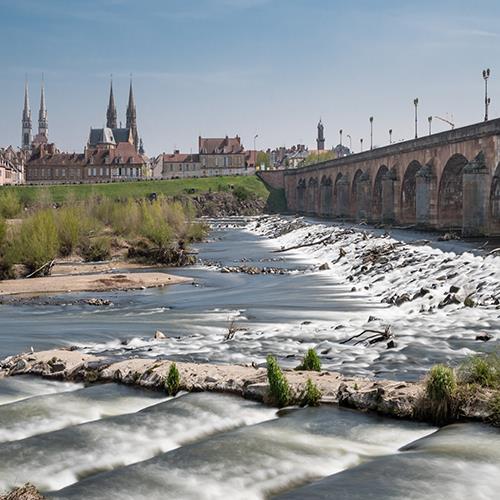
Issoire is a commune in the Auvergne-Rhône-Alpes region, located in the Puy-de-Dôme department, on the river Allier. It has a rich history dating back to the Roman era. In the Middle Ages, it was an important stop on the pilgrimage route to Santiago de Compostela.
Today, visitors can still see some of the medieval churches and archways that remain from this period. Issoire is also home to a beautiful Gothic cathedral, a UNESCO world heritage site which was built in the 13th century and in recent years, has become a popular destination for its scenic views and its many historical landmarks. The town also offers several outdoor activities, such as hiking and cycling.
Thiers
Thiers, located east of Clermont-Ferrand in the Puy-de Dome department, sits on the edge of the mountains of the Bois Noirs at 2,624 ft high. The town looks over the Limagne plain across to the Chaîne des Puys, boasting beautiful views. Explore the old streets, the medieval architecture and industrial history of the town. Thiers is synonymous with one thing: knife making. As the so-called ‘home’ of cutlery, Thiers manufactures as high as 80% of all common kitchen and pocketknives boasting the coveted ‘Made in France’ etching.