


Destinations
❮Main Menu
BASQUE COUNTRY - WHERE TO STAY


Bilbao
Picture-perfect Bilbao (Bilbo in Basque) is the cultural epicenter of Spain's Basque Country. It is the largest city and metropolitan area in northern Spain, and it is also one of the most heavily-industrialized cities in the country. Founded in the fourteenth century, Bilbao became one of the Kingdom of Castile's most important ports by the late Renaissance period. Situated between the Cantabrian Mountains and the Pyrenees, Bilbao is well-known for its temperate climate, as the city experiences cooler and wetter summers compared to other cities in Spain. In the early 1990s, the city government, inspired by the budding urbanist movement, green-lit the development of the Guggenheim Museum Bilbao, which revitalized the entire port area and the downtown area called Abando.
Speaking of Abando, if you are staying in Bilbao you will most likely want to stay in Abando. The Nervión River is the boundary to the east, while San Mamés Metro station and Sabino Arana Etorbidea are the boundaries to the west. In this area you will find the massive green space Casilda Iturrizar parkea, which is close to the Museum of Fine Arts of Bilbao on its eastern edge and the Itsasmuseum Bilbao (maritime museum) on the western edge. Much of the city's sights fan out from the roundabout to the northeast of the park, called Euskadi Plaza. To the northeast you will find the Guggenheim Museum Bilbao, which leads out to the Memoriaren Ibiltokia, another large gathering space. In the southeastern portion of Abando, there is another large roundabout, the Federiko Moiua Plaza, which is within walking distance from the beautiful 19th-century palace Txabarri Jauregia. The Abando train station and Metro stop are on the eastern end of the city center, near Bilbao's El Corte Inglés flagship department store. The Arriaga Theatre, the San Nicolas church, and Plaza Nueva sit just outside Abando across the Nervión from the train station.
The area east of Casilda Iturrizar parkea and north of Federiko Moiua Plaza is the place to find all different types of cuisine, ranging from Basque tapas bars to vegetarian restaurants, Italian cafés, and Japanese sushi restaurants. Many accommodations are clustered to the south of Casilda Iturrizar parkea and to the southwest of Plaza Sagrado Corazón de Jesús, adjacent to San Mamés Metro stop. More accommodations can be found on Abando's southern boundary near the N-634 motorway.


Vitoria-Gasteiz
Less than an hour to the south-southeast of Bilbao, you will find the Basque Country's de facto capital, Vitoria-Gasteiz. The city is hyphenated because Vitoria is the city's name in Spanish and Gasteiz is its name in Basque. The Basque capital reveals a Medieval quarter where it is possible to find the most charming little corners, gardens and tree-lined boulevards, where Medieval streets harmoniously intermingle with Renaissance palaces and Neoclassical churches. The center of the city's action is Plaza de la Virgen Blanca, presided over by the Battle of Vitoria monument. It is also the site of the church of San Miguel, which houses the image of the White Virgin, the city's patron saint. The present building dates between the 14th and 16th centuries, as evidenced by the mixture of Gothic and Renaissance elements. Take for example Vitoria-Gasteiz's medieval city center. Many buildings there date back to the 1500s and earlier and are very nicely preserved. The almond-shaped center is also partly surrounded by a wall from the 11th century along with several impressive watchtowers.
The city center of Vitoria-Gasteiz is where you want to be; it is roughly three-quarters of a mile from west to east, bounded in by the N-622 motorway to the west and Madrid Kalea and Jacinto Benavente Kalea to the east. You will find accommodations mostly to the south and southwest of Plaza de la Virgen Blanca, especially in the vicinity of Florida Park and Plaza Amárica. You will find yourself within walking distance of the Cathedral Maria Inmaculada, the Palacio Zulueta, and the Museo de Bellas Artes de Álava. The sights of the Medieval Quarter are located to the north of Plaza de la Virgen Blanca. While there are a number of restaurants close to your accommodations should you stay in the center of town, you will find more of them to the south and southeast of Plaza Simon Bolivar and to the west and north of Parque Judimendi.
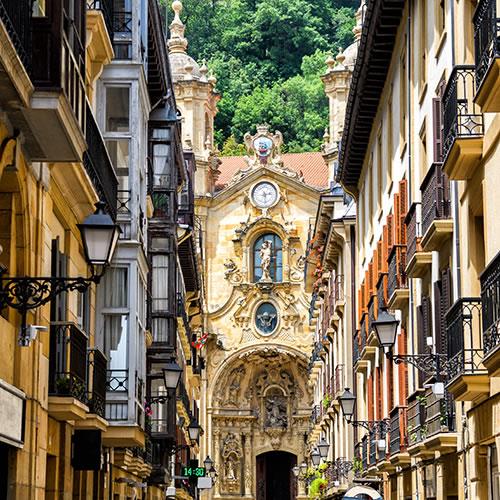
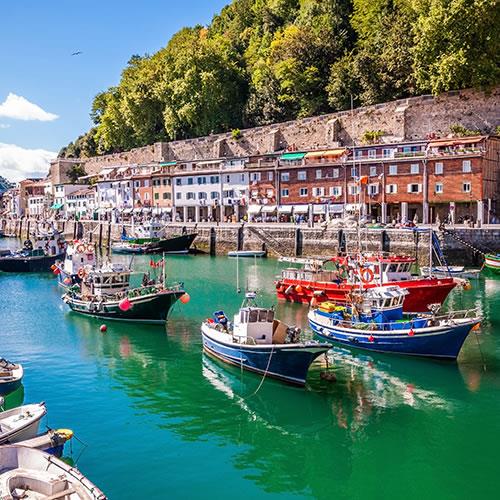
Donostia/San Sebastián
San Sebastián (Donostia in Basque) is one of the most popular, and most beautiful, coastal resort cities in all of Spain. It is located in the Basque Country, on the Green Coast along the Bay of Biscay, just twelve miles from the border with France. People come to Donostia/San Sebastián for a number of reasons, perhaps most importantly for the beaches, the food, and the ambience. The two beaches, Playa de la Concha and Playa de Ondarreta, are connected by a beachside promenade and sit on their own miniature bays. If you are looking to try Basque cuisine, you will eat very well here. Donostia/San Sebastián`s foodie scene is very diverse, boasting the second-highest number of Michelin-starred restaurants per capita in the world.
Out of the cities of the Basque Country, Donostia/San Sebastián has the most walkable city center and the most compact one. You will find accommodations in this area of the city are clustered into two groups. In the west you'll find many world-class hotels and resorts just off the beach of Playa de la Concha. To the east, you will find some nice hotels along the Urumea River. Normally we would tell you about specific areas of town that have higher proportions of restaurants and bars compared to others, but you will find that there are so many food choices no matter where you go in the city. Don't ignore the eastern bank of the Urumea because there are dozens of quality establishments over there as well. Don't get alarmed if you are not wanting to have a Michelin-starred dining experience every single time you go out; there are many pizzerias, tapas bars, and even American favorites like Starbucks and pizza chains like Domino's all over the city. (But where's the fun in that?)